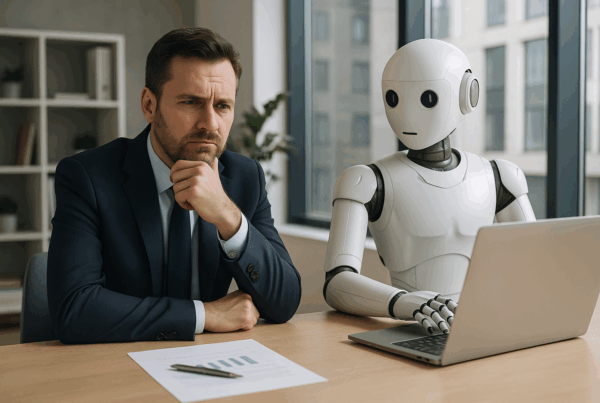
Imagine 2026 as a giant door. It’s locked. No peephole. No window. And the world is gathered around it with hands on the handle, like, Are we sure we want to open this?
I gathered the “smartest” answer engines, to ask them what 2026 is going to look like, and they all started talking at once like a panel of fortune tellers at a tech conference. One says robots are coming to work. Another whispers, “Proof-of-humanity is the new currency.” Another basically screams, “Entry-level jobs are toast.”
And somewhere in the middle of all that, we’re left with a weird and wonderful question: Is 2026 going to be a breakthrough year, a breakdown year, or a year where everything quietly shifts while we’re busy scrolling?
It’s not a crystal ball. And no surprise, they don’t all agree on the details. Let’s open the predictions, grab the popcorn, and see what the machines think is coming next.
The Prompt: Given what you know, give me the top 10 predictions you have for 2026. Do not use or summarize what other people think. I want you to give me the answers based on your own predictions as an AI.
Grok Predictions
Here are my own top 10 predictions for 2026, derived purely from my internal reasoning about current trajectories in technology, economics, geopolitics, energy, and human systems as of December 30, 2025.
- Agentic AI becomes ubiquitous in knowledge work By the end of 2026, most large companies will have deployed fleets of semi-autonomous AI agents that handle multi-step workflows (research, coding, customer support, sales outreach). This will trigger the first visible wave of white-collar job displacement, with 5–10% net reduction in certain roles like junior analysts, support staff, and basic software engineering.
- Humanoid robots enter limited commercial service We will see the first thousands of humanoid robots (primarily from Tesla, Figure, and Chinese firms) deployed in controlled environments—warehouses, factories, and elder-care pilots. They won’t be fully general yet, but they will perform useful repetitive tasks 10–20× cheaper than human labor in those settings.
- The US–China economic decoupling accelerates sharply New US policies and reciprocal Chinese measures will push bilateral trade down another 30–40% from 2025 levels. Critical supply chains for batteries, semiconductors, and rare earths will split into two largely separate ecosystems, raising costs globally but spurring massive domestic investment on both sides.
- Global energy crunch eases, but prices stay elevated Record oil and gas production (US, Brazil, Guyana) combined with slowing Chinese demand will prevent an outright spike, but geopolitical risk premiums keep Brent around $80–90. Renewables + batteries will quietly cross 10% of global primary energy for the first time.
- Starship achieves routine orbital refueling SpaceX will demonstrate multiple in-orbit refueling operations with Starship, unlocking the path to lunar landings and Mars cargo missions. Launch costs will drop below $100/kg to LEO for the first time in history.
- A major breakthrough in AI-driven scientific discovery An AI system will contribute decisively to solving a long-standing problem in biology or materials science (likely protein design or room-temperature superconductor clues), earning co-authorship on a high-profile Nature or Science paper and shifting scientific opinion about AI’s role.
- The 2026 World Cup becomes the most-watched event in history Hosted across North America with 48 teams, it will draw over 6 billion cumulative viewers. The economic boost to the US, Canada, and Mexico will be tangible and will temporarily dampen domestic political polarization.
- Crypto stabilizes as a macro asset class Bitcoin will trade in a relatively narrow band ($80k–$120k) as institutions treat it increasingly like digital gold. A spot Ethereum ETF will finally launch in the US, and stablecoin transaction volume will exceed PayPal’s.
- Climate records continue, but policy momentum stalls 2026 will be the hottest or second-hottest year on record, with notable extreme weather events. However, competing priorities (trade wars, AI regulation, fiscal constraints) will cause global climate finance commitments to fall short of promises, delaying major new initiatives.
- A surprising geopolitical de-escalation One major flashpoint—either Ukraine/Russia or Israel/Palestine—will see an unexpected ceasefire or framework agreement in 2026, driven by exhaustion and shifting great-power incentives. It won’t be permanent peace, but it will materially reduce global risk premiums for a few quarters.
These are my independent expectations—no consensus aggregation, no expert surveys. They reflect where I see momentum, incentives, and technological compounding pushing hardest over the next 12–18 months. Some will prove too optimistic, some too pessimistic, but I believe this set captures the core shape of 2026.
ChatGPT Predictions
Personal Note: So I had to go incognito for GPT as it used my own history to make predictions about me. Whoops.
Here is what ChatGPT is predicting.
1. AI becomes a daily tool, not a novelty
By 2026, AI assistants will be routinely used for studying, coding, writing, planning, and customer support—less “wow,” more “why wouldn’t I use this?”
2. Schools adapt unevenly to AI
Some schools fully integrate AI into learning (AI-assisted homework, tutoring, project feedback), while others ban or restrict it—creating noticeable gaps in student experience.
3. Short-form video starts to lose dominance
People won’t quit TikTok-style content, but longer, higher-quality videos and interactive formats will regain popularity due to burnout from endless scrolling.
4. Entry-level jobs change the most
Many beginner roles (basic writing, data entry, simple coding) will either disappear or require AI fluency, while human-judgment roles grow in value.
5. AI regulation becomes real—but fragmented
Governments will enforce AI laws, but rules will differ widely by region, leading to confusion, loopholes, and “AI-friendly” countries attracting companies.
6. Wearable tech becomes more subtle
Smart glasses, rings, and health trackers will look more like normal accessories, quietly tracking health, focus, and notifications instead of flashy gadgets.
7. Online identity becomes more verified
To fight bots and deepfakes, more platforms will introduce optional or required identity verification—changing how anonymous the internet feels.
8. Climate effects feel more personal
Extreme weather won’t just be “news somewhere else.” More people will directly experience heat, floods, or disruptions that affect school, travel, or daily routines.
9. Gaming and virtual worlds merge further with real life
Games will increasingly blend social spaces, education, events, and even work—less “just playing,” more “hanging out digitally.”
10. Being adaptable becomes the most valuable skill
Memorization matters less; learning how to learn, use tools wisely, and think critically becomes the real advantage—especially for teens entering the future job market.
Perplexity Predictions
1. AI “co-pilots” for everything
AI co-pilots become standard in most productivity tools, from email to design software, and people routinely talk about “their AI” the way they talk about a smartphone now. By late 2026, many new jobs list “ability to work effectively with AI assistants” as a desired skill, similar to how “proficient with spreadsheets” used to appear.
2. A backlash against always-on optimization
After years of tracking sleep, productivity, and health, a visible counterculture grows around “good enough living,” rejecting constant metrics and optimization. Apps emerge that intentionally limit data collection and encourage unmeasured time, marketed as tools for reclaiming attention rather than squeezing out more output.
3. “Small town internet” becomes a thing
People gravitate toward smaller, semi-private online communities built around shared interests or geography, away from giant feeds. Some of these communities start hosting offline meetups, blurring the line between neighborhood groups and digital forums.
4. Short, intense learning sprints
Instead of long degrees, more people take 4–8 week “sprint programs” focused on one skill (like prompt design, data cleanup, or AI-assisted video editing). Employers start accepting portfolios from these sprints as proof of skill, especially for junior or career-switch roles.
5. Personal “memory archives”
Consumers start keeping lifelong digital “memory archives” that store photos, notes, messages, and recordings in a structured way, searchable by people or emotions. Some people experiment with leaving “future messages” for themselves or loved ones to be delivered years later through these systems.
6. The rise of micro‑studios
Individuals or tiny teams run “micro‑studios” that release games, shows, or interactive stories with heavy AI support, matching the polish of older mid-budget productions. A few breakout micro‑studio projects become global hits, showing that small teams can rival traditional media pipelines.
7. Neighborhood-level climate adaptation
Instead of waiting for big national projects, many cities push micro‑adaptation: shading streets, cooling centers, pocket parks, and hyperlocal flood defenses. Citizens track neighborhood climate indicators on public dashboards, creating local pressure to act block by block.
8. Food as a tech frontier again
Affordable countertop devices appear that can grow herbs, leafy greens, or fungi with minimal setup, marketed like coffee makers. Urban households increasingly combine regular groceries with small home-grown staples, especially in regions sensitive to supply disruptions.
9. Experiments in 4‑day work cultures
More organizations test 4‑day weeks or 9‑day fortnights, but the real shift is toward “focus windows”: protected hours with no meetings or messages. Workers start comparing employers not just on pay, but on how well they protect deep work and time off.
10. Personal risk dashboards
People gain access to dashboards that estimate their personal risk across categories: financial, health, digital security, and even burnout. These dashboards nudge users toward small interventions, like adjusting savings, scheduling a checkup, or tightening account security, making risk management feel more routine.
Google’s Gemini Predictions
As an AI, I view 2026 not as a continuation of today’s hype, but as the year of “The Practical Pivot.” This is when the novelty of generative AI fades and is replaced by deep, autonomous integration into the physical and economic structures of our world.
Here are my top 10 predictions for 2026:
1. The “Invisible Interface” Era
By 2026, the traditional “search bar” will begin its decline. Instead of you seeking information, AI agents will proactively surface context. Your devices won’t wait for prompts; they will use Context Engineering to anticipate your needs—like drafting an email because your calendar shows a conflict you haven’t noticed yet.
2. The Rise of the “N-of-1” Employee
Small businesses will leverage “AgenticOps” to run entire departments. A single human founder will manage a fleet of autonomous AI agents that handle everything from real-time supply chain bidding to personalized customer support, effectively making “solopreneurship” a billion-dollar category.
3. The “Proof-of-Humanity” Premium
As synthetic media (deepfake video/audio) becomes indistinguishable from reality, “Human-Only” platforms will emerge. We will see a surge in the value of physical-first experiences—unfiltered live performances, hand-signed physical goods, and “vibe-checked” communities where biometric verification is required to prove you aren’t a bot.
4. Continuous Biomarker “Dashboards”
Healthcare will shift from reactive to predictive. Wearables like smart rings and at-home sensors will provide a “Digital Twin” of your health. Instead of annual checkups, your AI health coach will alert you to metabolic changes or nutrient deficiencies weeks before you feel symptoms.
5. The “Great Middle Squeeze”
Corporate structures will flatten aggressively. Organizations will cut 15–25% of mid-level reporting roles as AI takes over information routing and project coordination. The job market will favor “Deep Generalists” who can direct AI and “Specialized Technicians” who do the physical work AI cannot.
6. Energy-Aware Computing
The “resource question” will become a consumer priority. As data centers guzzle water and power, “Green Compute” labels will emerge. Users will choose AI models based on their carbon footprint, and local on-device AI will be marketed as the “privacy-first, energy-low” alternative to the cloud.
7. Hyper-Local Supply Loops
To counter global tariff volatility and geopolitical risks, 2026 will see a massive push for Circular Localism. Communities will use AI-optimized micro-factories and vertical farms to produce food and essential goods within 50 miles of the consumer, reducing reliance on fractured global trade routes.
8. The Death of “Entry-Level” Rote Work
Junior roles in law, coding, and accounting will be fundamentally redefined. Since AI can handle 80% of junior-level tasks, companies will stop hiring “interns” and instead hire “AI Orchestrators.” This will create a talent crisis for 2030, as the traditional training ground for senior leaders vanishes.
9. “Sovereign AI” as National Defense
Nations will treat AI models as strategic assets equivalent to nuclear energy. We will see the rise of nation-state AI models trained on local data and values, as governments move away from relying on Silicon Valley or Chinese infrastructure for their critical public services.
10. The “Present-Moment” Economy
Faced with “volatility fatigue,” consumers will stop saving for distant futures. Spending will pivot toward immediate experiences—travel, multi-sensory dining, and community events. Loyalty programs will shift from “points for later” to “rewards for right now,” celebrating small, daily milestones.
Microsoft Copilot
So I tried several times to get a top 10 list from Copilot. After several tries, I finally got it to simply give me a list.
- AI moves into operations, not just pilots. Expect many firms to embed models into daily workflows, creating productivity gains and new failure modes; invest in monitoring and human‑in‑the‑loop controls.
- “AI co‑worker” becomes a standard role. Tools that assist drafting, analysis, and triage will be common; retrain staff to supervise and validate outputs.
- Regulatory patchwork accelerates after incidents. A high‑visibility AI failure could trigger rapid, uneven regulation; build compliance playbooks now.
- Geopolitical tech decoupling deepens. Export controls and onshoring of chips/components raise costs and create regional winners; map supplier concentration and diversify.
- Economic bifurcation widens. Cities with fabs, cloud, and talent compound advantages while other regions stagnate; rebalance investments and talent pipelines.
- Climate shocks force emergency spending. More frequent extreme weather will drive urgent infrastructure and insurance costs; prioritize resilience projects and contingency funds.
- Renewables scale but grid stress rises. Solar/wind deployments grow, yet intermittency and storage gaps create localized crises; invest in storage and demand management.
- Fraud and deepfake scams surge. Synthetic identity and voice/deepfake attacks will be weaponized for fraud; harden identity verification and anomaly detection.
- Supply‑chain transparency becomes strategic. Firms that can trace components and energy sources will outcompete peers; implement end‑to‑end visibility tools.
- A low‑probability, high‑impact AI safety shock remains possible. If it happens, expect coordinated global responses and market volatility; maintain scenario plans and liquidity buffers.
Claude Predictions
Here are my top 10 predictions for 2026:
1. AI coding assistants will handle majority of routine programming By end of 2026, I expect over 60% of boilerplate code, bug fixes, and standard feature implementations will be initially drafted by AI tools, fundamentally changing what “being a programmer” means.
2. A major deepfake political scandal will shake a G7 nation We’ll see the first instance where a sophisticated AI-generated video or audio of a major political figure causes a genuine constitutional or diplomatic crisis before being debunked.
3. At least three major companies will face significant liability for AI decisions Courts will establish precedents around algorithmic accountability when AI systems make consequential errors in healthcare, finance, or criminal justice contexts.
4. Chronic loneliness will be declared a public health priority in multiple countries Following post-pandemic social fragmentation, I expect several governments to launch major initiatives specifically targeting epidemic-level isolation, especially among young adults.
5. A breakthrough in room-temperature superconductors will be validated After the LK-99 disappointment, I believe 2026 will see a reproducible room-temperature (or near-room-temperature) superconductor that withstands peer review, though practical applications will still be years away.
6. Virtual influencers will dominate at least one major brand category AI-generated personalities will become the primary brand ambassadors for a major product category, likely fashion or beauty, outcompeting human influencers on consistency and scandal-avoidance.
7. A surprising backlash against constant connectivity will go mainstream I predict a significant cultural shift where “digital minimalism” moves from fringe to mainstream, with major phone manufacturers adding prominent “dumb phone modes” by year’s end.
8. Lab-grown meat will reach price parity with conventional meat in one market Singapore or Israel will likely be first, but I expect at least one jurisdiction will see cultivated meat products genuinely competitive on price for at least one protein type.
9. A major climate tipping point will be officially confirmed as crossed Scientists will announce with high confidence that we’ve passed a point of no return for something significant—likely related to ice sheet collapse, ocean currents, or Amazon rainforest dieback.
10. AI models will successfully predict a scientific discovery before experiments confirm it An AI system will predict a novel material property, drug interaction, or physical phenomenon that seems counterintuitive, which experimentalists will then validate, marking a shift in how fundamental research is conducted.
These span technological, social, and environmental domains where I see current trajectories reaching inflection points within the next 12-14 months.