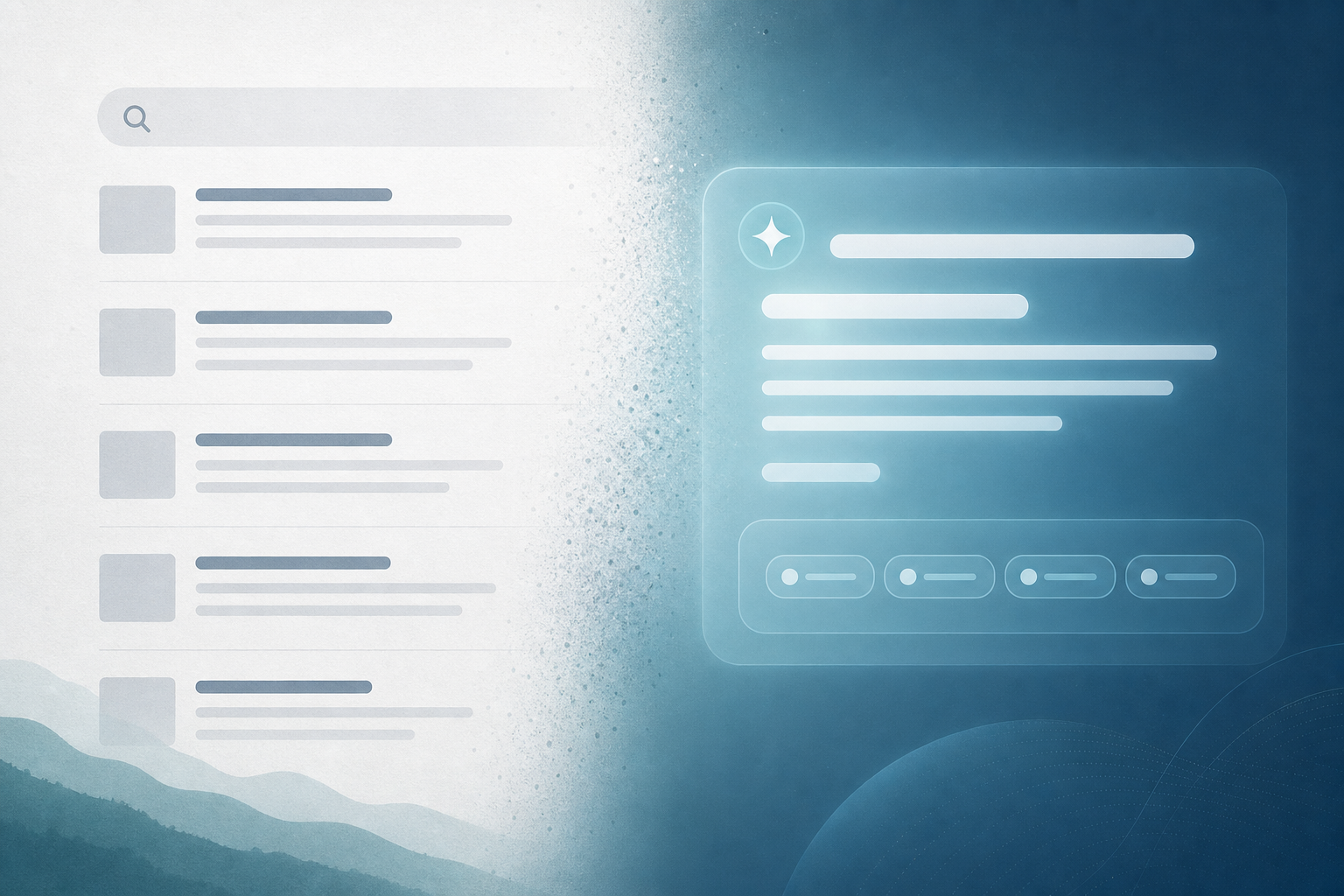
Yes: a page can rank on Google and still be invisible in AI answers. Organic position proves searchers can find your blue link. It does not prove an answer engine will retrieve, quote, or cite that page when someone asks the same question in ChatGPT, Perplexity, Gemini, or an AI Overview. Those are related systems with different products, different success metrics, and different failure modes.
If you sell SEO retainers, run an in-house content team, or brief a client who just sent a screenshot of “position 3” and asked why the brand never shows up in AI replies, this post is the conversation guide. We will keep the client language short, then give you a diagnosis checklist you can run without inventing a fake “AI rank” number.
This is not a rewrite of our broader operating guide on staying visible in search and AI. It is the focused rank-versus-citation spoke: what each report proves, what it misses, and what to change next when the two dashboards disagree.
The client-ready explanation (use this first)
When a client (or an executive) asks why strong Google rankings are not showing up in AI answers, start here:
“Google ranking means your page is competitive for clicks in classic search results. AI answers assemble a short response from passages they retrieve and trust for that question. A page can win the click contest and still lose the passage contest if it is hard to quote, thin on evidence, poorly matched to conversational intent, or outside the candidate set the engine pulls. So we measure both: rank and CTR in Search Console, and mention or citation checks in AI answers. Then we fix the gap with clearer answer blocks, fresher sources, and topic coverage, not with another vanity rank report.”
That paragraph usually lands better than a lecture on retrieval-augmented generation. It respects the SEO win, names the second job, and points to action instead of panic.
If you need a one-liner for Slack: ranking is about being chosen from a list; AI visibility is about being usable inside an answer.
What Google rank proves (and what it does not)
A healthy rank report is still valuable. Average position, impressions, and clicks tell you whether classic search demand is finding your URLs. For many commercial queries, that traffic still pays the bills. Rank also correlates with crawlability, topical relevance, and competitive strength. Those qualities help AI systems too. They just are not enough on their own.
Here is what a strong Google rank usually proves:
- Your page is relevant enough for Google to show it for the query set you care about.
- You have enough authority and internal support to compete on that SERP.
- You can earn visits if titles, snippets, and SERP features cooperate.
Here is what it does not prove:
- That an answer engine retrieved your page for the conversational version of the question.
- That any passage on the page was extractable enough to quote cleanly.
- That your brand was mentioned, cited, or recommended in the synthesized reply.
- That click-through rates will stay stable as AI Overviews and answer panels change SERP layout. Related pressure shows up when click-through rates drop even on page one.
In practice, we see teams celebrate a position improvement, then feel blindsided when a prospect says, “I asked ChatGPT and your competitors came up.” Both can be true at the same time. The reports are measuring different outcomes.
What AI citation visibility proves (and what it misses)
AI visibility checks are messier than Search Console. Engines differ. Prompts differ. Answers change day to day. Still, a structured check tells you something rank alone never will: whether your content is entering the answer layer.
When we talk about AI visibility for businesses, we usually separate three outcomes:
- Mention: the brand or URL appears in the answer text.
- Citation: a claim or passage is attributed to a specific source.
- Recommendation: the answer steers the reader toward you as a next step or vendor.
A page can rank on page one and still fail all three. Or it can sit lower in classic SERPs and still get cited because a passage answers a sub-question cleanly. That is why teams who only watch average position under-invest in quotable structure, entity clarity, and evidence density.
For a deeper look at how engines choose sources, pair this post with our mechanics guide on how AI answer engines select and cite sources. For the “how do we earn citations” playbook, use content cited in AI-generated answers. This article stays on the education and diagnosis problem: ranking ≠ citation.
Side-by-side: Google rank report vs AI citation check
Put both reports on the same slide when you brief a client. The contrast is the point.
| Question | Google rank / GSC report | AI citation / presence check |
|---|---|---|
| What does a “win” look like? | Higher position, more impressions, more clicks | Mention, citation, or recommendation in answers |
| Primary product | List of links for humans to choose | Synthesized answer that may include sources |
| Best for proving | Discoverability in classic search | Usability inside answer experiences |
| What a strong score misses | Whether passages get quoted elsewhere | Whether the site still earns organic clicks |
| Typical false comfort | “We’re #3, so AI will find us” | “We got one mention, so SEO is fine” |
| Refresh signal | Position slip, impression loss, CTR drop | Lost citations, competitor takeovers, stale answers |
Neither column replaces the other. Finance still cares about pipeline from organic sessions. Product and brand leaders increasingly care whether AI answers name you when buyers research. Your job is to keep both dashboards honest instead of collapsing them into one fake KPI.
Why the gap happens so often
Most “we rank but AI ignores us” cases come from a small set of causes. Walk them in order before you rewrite the entire site.
1. Conversational intent does not match the ranking page
A page may rank for a head term because it covers the commercial cluster well, while the AI prompt is a how-to, comparison, or definition question. The engine looks for a passage that answers that shape of question directly. If your winner is a long narrative without a clear answer block, retrieval may skip it for a thinner but clearer competitor page.
2. The page is hard to extract
Answer engines prefer passages that travel well: definitions in one or two sentences, labeled steps, compact tables, FAQ answers with a complete thought. Walls of hedging, buried ledes, and screenshot-only evidence are painful to quote. Classic SEO can still reward that page if the overall topical coverage is strong.
3. Evidence and freshness look weak for answer use
A page can keep a decent rank on brand-adjacent queries while its statistics, product details, or process steps drift out of date. Answer systems that favor current or well-sourced claims may prefer another domain. Rank decay can lag behind citation loss, which is why waiting for the GSC cliff is a bad strategy.
4. Entity and brand clarity is fuzzy
If the page never states who you are, what category you belong in, or how you relate to the problem, humans can still infer it from design and navigation. A retrieval stack has less patience. Ambiguous “we help companies grow” intros hurt AI selection more than they hurt Google clicks from branded traffic.
5. You are winning clicks while SERP features steal attention
Sometimes the Google report still looks fine in position while CTR softens because AI Overviews, featured snippets, or other panels sit above the organic list. That is adjacent to, not identical with, AI citation invisibility, but clients often conflate the two. Separate “we get fewer clicks on Google” from “we never appear in ChatGPT.” Different fixes.
Five-step diagnosis checklist
Use this when someone says the brand ranks well but is invisible in AI answers. Time-box it. You want a decision, not a research project.
- Confirm the Google claim with the same query set. Pull Search Console for the URL and the exact queries the client cares about. Note position, impressions, clicks, and CTR for 28 and 90 days. If “we rank” means position 12 on a branded variant, reset expectations before you talk about AI.
- Run a fixed AI prompt set. Use 8 to 12 prompts that mirror buyer language: definition, how-to, comparison, “best for,” and objection handling. Keep the set stable month to month so you can see change. Log mention, citation, and recommendation separately. Our notes on how to track presence in AI search help you avoid one-off screenshots as strategy.
- Compare the ranking URL to the cited URLs. For prompts where competitors appear and you do not, open the cited pages. Ask: do they answer in the first screen? Do they include a definition, steps, or table you lack? Is their entity clearer? This is usually where the gap becomes obvious.
- Score extractability on your ranking page. Can you highlight a 40 to 80 word answer that would stand alone if quoted? Is there an H2 that matches the prompt? Are claims sourced? If not, the fix is structural before it is promotional.
- Pick one primary action per page. Choose among: add a quotable answer block, refresh evidence, split a mismatched intent into a spoke, strengthen internal links from the cluster, or accept that this URL is a click asset and a different URL should own AI answers. One primary action beats a vague “optimize for AEO” ticket.
Write the outcome as a short memo: what Google proves, what AI checks show, the likely cause, and the next change. That memo is what clients actually need.
How to explain the gap without sounding like excuses
Agencies lose trust when the explanation sounds like special pleading. Keep these rules:
- Credit the SEO win. Do not dismiss rank. Say what it is buying: discoverability and traffic.
- Name the second KPI clearly. AI mention or citation rate on a fixed prompt set is a separate scorecard.
- Avoid fake precision. Do not invent an “AI rank #4” unless you have a defined method and caveats.
- Show a competitor page that wins the passage contest. Concrete beats theory.
- Propose a two-track plan. Track A protects organic clicks. Track B improves answer usability on priority prompts.
A useful framing for quarterly business reviews: “Search Console tells us whether we are findable. AI checks tell us whether we are quotable. This quarter we will keep positions on X queries and earn citations on Y prompts.”
If leadership only funds one track, be honest about the trade-off. Protecting CTR on page one and earning citations are related, but they compete for editorial time.
What to change on pages that rank but do not get cited
Once diagnosis points to extractability or intent mismatch, these edits tend to move the needle faster than another backlink push.
Lead with a complete answer
Put a plain-language answer near the top of the section that matches the prompt. Two to four sentences that could be quoted without the surrounding essay. Then expand with nuance. Answer engines and humans both benefit.
Add scannable evidence
Use short lists, comparison tables, and labeled steps. Cite reputable sources when you use statistics, and date-stamp process claims when they change. You do not need denser prose. You need clearer units of meaning.
Clarify the entity early
State the product category, audience, and problem in the opening. Ambiguous brand language is a tax on retrieval. Internally linked hub pages that define the category help both classic SEO and AI selection.
Align spokes to conversational prompts
If your ranking URL is a broad pillar, build or refresh a spoke that answers the exact AI question shape. Link both ways. Pillars win breadth; spokes often win quotes.
Refresh before you expand
Outdated examples, old product names, and stale “as of” claims quietly kill trust. A refresh cycle on high-rank pages is often cheaper than writing a net-new article that duplicates intent.
Measurement that keeps both teams honest
Build a lightweight scorecard. Keep it boring on purpose.
- Organic track: impressions, clicks, CTR, average position for priority URLs and queries.
- AI track: % of fixed prompts with mention, % with citation, competitive share of citations, notes on answer quality.
- Bridge metrics: pages updated for extractability, spokes shipped for mismatched prompts, internal links added from hubs.
Review monthly. Do not overreact to a single prompt swing. Do react when the same five buyer prompts keep citing the same three competitors for a quarter while your rank report looks calm. That pattern is the classic “rank on Google, invisible in AI answers” problem in the wild.
If you already track AEO experiments, connect this diagnosis to your roadmap metrics rather than inventing a parallel religion. The point is attribution of effort, not more dashboards nobody opens.
Common objections (and straight answers)
“If we rank #1, AI has to use us.” No. Rank is a strong prior, not a guarantee. Answer selection cares about passages and candidate sets, not only classic position.
“AI visibility is unmeasurable, so we should ignore it.” It is noisier than GSC, not useless. A fixed prompt set with logged outcomes is enough to steer editorial priorities.
“We will wait until Google folds AI into Search Console.” You can wait. Competitors who make pages easier to quote will not. The content debt compounds.
“This means SEO is dead.” No. It means SEO reports alone under-describe buyer research. Keep earning clicks. Also earn quotability.
A sample client email you can adapt
Subject: Ranking vs AI citations on [topic]
Body sketch:
We checked the URLs that rank for [queries]. Search Console shows [position / CTR summary]. That is real progress for classic search traffic.
We also ran our fixed AI prompt set for buyer questions around [topic]. Your pages were [mentioned / cited / absent]. Competitors that appeared tended to have clearer answer blocks and fresher evidence on the exact question shape.
Next step: we will [add answer blocks / refresh sources / ship a spoke] on [URL], then re-check the same prompts in 30 days. We will keep reporting Google clicks and AI citations as separate lines so we do not mix the two wins.
Short, calm, specific. That tone prevents the meeting from becoming a debate about whether AI “counts.”
Turn rank-vs-citation gaps into an AEO plan
If your team can already prove strong Google positions but cannot show mentions or citations on the prompts that matter, you do not need another generic visibility essay. You need a diagnosis memo, a fixed prompt set, and a short list of page edits that make your best URLs easier to retrieve and quote.
We help marketing leaders separate what Search Console proves from what AI answer checks prove, then build a two-track plan that protects organic clicks while improving answer visibility. If you want that mapped on your priority pages, request an AEO visibility audit and we will walk the rank-versus-citation gap with you.
Ranking vs AI citation questions clients ask
Straight answers on why Google rank and AI citations diverge, how to explain the gap, and what to check before you rewrite a ranking page.
Can a page rank on Google and still be invisible in AI answers?
Yes. Google ranking measures how competitive your URL is for classic search results and clicks. AI answers assemble a synthesized response from passages they retrieve and trust for a prompt. Those systems overlap, but they optimize for different products. A page can sit in the top three for a head term and still never be quoted if its passages are hard to extract, mismatched to conversational intent, or outside the candidate set an engine pulls.
That is why a strong average position is not a substitute for mention and citation checks. Treat rank as proof of discoverability in search, and AI presence as proof of usability inside answers. When the two disagree, diagnose extractability and intent before you assume the SEO program failed.
How do I explain this gap to a client without sounding like excuses?
Lead with respect for the SEO win, then name the second KPI. Say that position and clicks show the page is findable in classic search, while AI checks show whether the page is quotable in answer experiences. Keep the language concrete: show the ranking URL, the prompt set, and a competitor page that won the citation with a clearer answer block.
Avoid inventing a fake AI rank number. Propose a two-track plan: protect organic CTR and improve extractability on priority prompts. Clients usually accept the gap when they see a specific next edit and a re-check date instead of a philosophical debate about whether AI search is real.
What should I compare in a Google rank report versus an AI citation check?
In Search Console, look at queries, pages, impressions, clicks, CTR, and average position for the same time window. That tells you whether classic demand is finding you and whether people choose your result. In an AI check, log a fixed prompt set and score mention, citation, and recommendation separately. Note which competitor URLs appear when you do not.
Put both on one slide. The rank report proves discoverability. The AI check proves answer-layer presence. Neither column should be used to dismiss the other. The useful output is the gap narrative: what each dashboard shows, what it misses, and which page action closes the mismatch.
What are the most common reasons ranking pages fail to get cited?
The frequent causes are conversational intent mismatch, weak extractability, stale evidence, fuzzy entity clarity, and confusing CTR loss from SERP features with true AI invisibility. Ranking pages often win on breadth and authority while losing on a clean 40 to 80 word answer that matches the prompt shape.
Start by comparing your ranking URL to the cited competitor pages for the same prompts. If they answer earlier, use clearer lists or tables, or state the entity more plainly, that is your editorial brief. Fix structure and freshness before you assume you need a brand-new link campaign.
What is a practical five-step diagnosis for this problem?
First, verify the Google claim in Search Console for the exact queries at stake. Second, run a stable AI prompt set and log mention versus citation versus recommendation. Third, compare your ranking URL to the URLs that get cited. Fourth, score whether your page has a quotable answer block. Fifth, assign one primary action: rewrite for extractability, refresh evidence, ship a spoke, improve internal links, or accept that another URL should own AI answers.
Document the result in a short memo with a 30-day re-check. The checklist keeps the conversation operational so teams do not stall in abstract debates about model behavior they cannot control.
Should we stop investing in SEO if AI answers ignore our top pages?
No. Organic search still drives discovery and pipeline for many businesses, and the qualities that support rankings often help retrieval too. Stopping SEO because AI citations lag would throw away a measurable traffic channel while you learn a noisier one. The better move is dual measurement and dual editorial work.
Keep protecting positions and CTR on commercial queries. In parallel, make high-value pages easier to quote and build spokes for conversational prompts where competitors already win citations. SEO is not dead. SEO-only reporting is incomplete.
How often should we re-check AI visibility if rankings look stable?
Monthly is enough for most B2B teams once a fixed prompt set exists. Rankings can look calm for weeks while citation share shifts on buyer questions, especially in competitive categories. A monthly pass catches competitor takeovers and stale passages without reacting to every one-off answer change.
Re-check sooner after a major content refresh, product launch, or SERP feature shift that changes CTR on page one. Keep the prompt set stable so you compare like with like. Screenshots without a baseline are anecdotes, not a program.
What page changes help most when we rank but stay invisible in AI answers?
Prioritize a complete answer near the matching H2, scannable lists or tables, clearer entity language, fresher evidence, and spokes that match conversational prompt shapes. Those edits improve extractability without abandoning the SEO equity you already earned.
Link hubs and spokes both ways, and avoid stuffing every AI tip onto the same ranking URL if intent is split. Measure success with the same prompt set you used in diagnosis. If citations still do not move after structural fixes, expand the candidate set with better topical coverage rather than chasing vanity metrics.