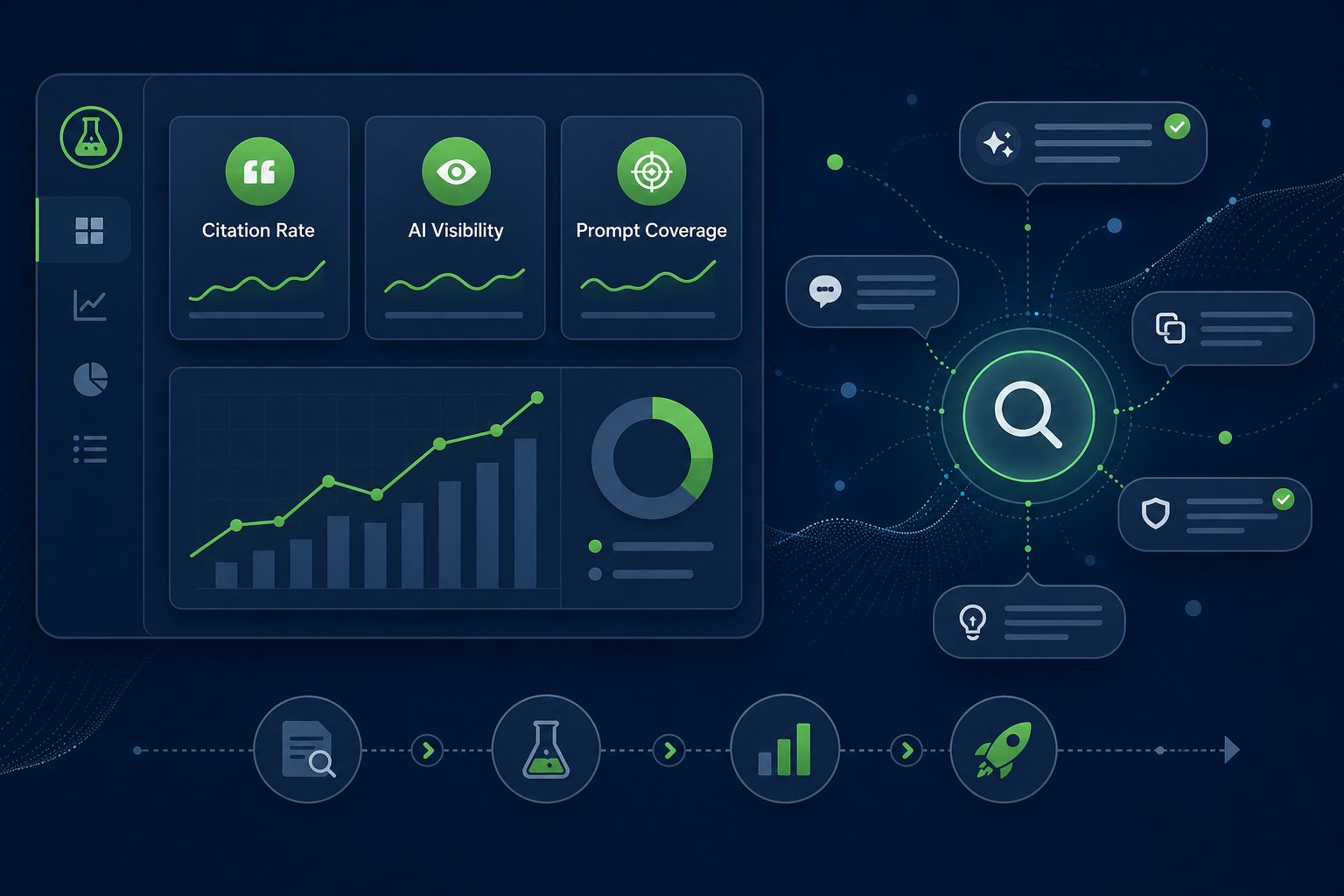
Most marketing teams can tell you how many blog posts they published last quarter. Far fewer can tell you whether those posts show up when someone asks ChatGPT, Perplexity, or Google AI Overviews a question your brand should own. That gap is why AEO metrics to track matter now. Answer Engine Optimization is not a replacement for SEO. It is a parallel measurement layer on top of it, and you need both if you want content that ranks, gets cited, and still drives pipeline.
This post gives you a short list of metrics that actually change decisions, plus a 90-day experimentation roadmap you can run without buying another dashboard on day one. We focus on a manual prompt log joined to Search Console and GA4, because that workflow works for most B2B teams before they scale into paid AEO tools.
If you have not set up basic AI search monitoring yet, start with our guide on how to track presence in AI search. This article assumes you can run a repeatable prompt check and want to know what to measure next.
What AEO metrics actually measure
AEO metrics track whether your brand and content appear in AI-generated answers, not just traditional blue links. The unit of success shifts from “did we rank?” to “did an answer engine mention us, cite our URL, or send a click when someone asked a buying question?”
That sounds simple until you try to score it. AI answers vary by model, user, and session. Citations may link to your homepage, a blog post, or a third-party review site. Some engines answer without links at all. Good AEO measurement accepts that noise and still produces trends you can act on.
Think of AEO metrics in three buckets: visibility (did we show up?), authority (did they cite us as a source?), and outcome (did the visit or conversion happen?). Most teams over-index on visibility and ignore outcome. The roadmap below balances all three.
Why you need a roadmap, not just a metric list
Lists of KPIs stall when nobody knows what to do with a number. A 90-day roadmap forces sequence: baseline first, then experiments, then pipeline connection. Without that order, teams either buy tools they cannot interpret or rewrite random posts because a competitor got cited once.
Experimentation also keeps AEO honest. A single citation win might be luck. Three months of logged prompts, content changes, and before/after citation rates tells you whether your structure, freshness, or entity clarity actually moved the needle.
We run this loop with clients who already have content measurement frameworks for organic search. AEO slots into the same monthly review. You are not building a second content program. You are extending the one you have.
Core AEO metrics to track (with plain definitions)
Start with six metrics. Add more only when these six produce a stable monthly read and your team acts on them.
| Metric | What it measures | How to capture it (manual start) | Decision it supports |
|---|---|---|---|
| Citation rate | Share of priority prompts where your domain appears as a linked source | Prompt log: cited yes/no per URL per run | Which topics and pages earn trust as references |
| Brand mention rate | Share of prompts where your company name appears in the answer text, with or without a link | Prompt log: mention yes/no | Entity recognition vs deep content citation |
| Prompt coverage | How many priority questions you actively test each month | Count rows in your prompt library with a check date | Whether your sample represents real buyer intent |
| Share of answer | When cited, how prominently your brand or page appears (lead citation, supporting source, footnote only) | Simple 1–3 score per cited prompt | Whether you are the recommended option or an also-mentioned source |
| AI-attributed traffic | Sessions from AI referrers or tagged AI-assisted journeys in GA4 | GA4 exploration by referrer and UTM where available | Whether visibility converts to site visits |
| Pipeline touch rate | Share of AI-influenced sessions that reach a key event (demo, contact, signup) | Join landing page + event reports in GA4 | Whether AEO work connects to revenue, not vanity citations |
| Citation freshness | How often cited pages were updated in the last 90 days | Content audit date vs citation log | Whether living content maintenance keeps AI references |
You do not need perfect attribution on day one. You need consistent definitions. If citation rate means “linked URL from our domain” this month, keep that definition next month. Changing the rule every week makes every chart lie.
Our overview of content cited in AI-generated answers goes deeper on why some pages earn links in answers while others only get a passing mention. Use that post when your team debates what “citation” should count.
What to track now vs what to defer
Not every AEO signal deserves a column in your spreadsheet. Track now: citation rate and brand mention rate on 20–40 priority prompts, AI-attributed traffic in GA4, and pipeline touch rate on URLs that already matter for organic. Defer until month two or three: sentiment scoring, competitor share of voice across ten models, and granular prompt-level ROI models.
Also defer tool sprawl. A paid AEO platform can help at scale, but a shared prompt log plus GSC and GA4 beats an empty dashboard every time. Teams that skip the manual phase usually cannot explain a spike or drop when the tool changes its index method.
If leadership asks for one executive number before you have three months of data, use citation rate on commercial prompts only. It is imperfect, but it maps to a story: “We show up as a cited source on X percent of buying questions we care about.”
Build your prompt library before you optimize anything
Your prompt library is the spine of AEO measurement. Without it, citation rate is whatever someone remembered to ask ChatGPT on Tuesday.
Start with 25–40 prompts grouped by intent: problem-aware, solution-aware, comparison, and brand-navigational. Pull language from sales call notes, GSC query exports, and customer support tickets. Write each prompt the way a buyer would ask an assistant, not the way your SEO brief would phrase a keyword.
Assign each prompt a tier: Tier 1 prompts tie directly to pipeline (pricing, alternatives, implementation). Tier 2 prompts support authority (how-to, definitions). Tier 3 prompts are monitor-only (tangential thought leadership).
Run Tier 1 prompts weekly, Tier 2 biweekly, Tier 3 monthly. Log model, date, citation yes/no, mention yes/no, URLs cited, and a one-line note on answer quality. Same person, same browser profile if you can. Consistency beats volume.
90-day AEO experimentation roadmap (week by week)
This table is the operating plan. Adjust dates to your calendar, but keep the sequence. Baseline before content rewrites. Content tests before pipeline claims.
| Week | Focus | Actions | Output |
|---|---|---|---|
| 1 | Scope | Pick 15–20 Tier 1 URLs; draft prompt library; define citation rules | Prompt sheet v1, URL priority list |
| 2 | Baseline run | Run full prompt set on 2 engines; log citations and mentions | Baseline citation rate and mention rate |
| 3 | Analytics join | Map prompts to landing pages; pull GSC queries and GA4 landing reports | URL ↔ prompt ↔ query alignment doc |
| 4 | Gap review | Flag URLs with high GSC impressions, zero citations; note competitor citations | Top 10 gap list for experiments |
| 5 | Structure test | Add FAQ blocks, clear definitions, and citation-friendly summaries on 3 pages | Before snapshot saved |
| 6 | Freshness test | Update stats, examples, and dates on 3 different pages | Change log per URL |
| 7 | Entity test | Improve author bios, about page links, and internal links to target hubs | Internal link map updated |
| 8 | Midpoint measure | Re-run full prompt set; compare to week 2 baseline | Midpoint citation rate delta |
| 9 | Cluster test | Publish or refresh one supporting spoke tied to a hub page | New or updated URL in log |
| 10 | Snippet alignment | Rewrite titles and meta for pages with impressions but weak AI mentions | Title change log |
| 11 | Pipeline join | Review GA4 events on AI-influenced landings; note conversion paths | Pipeline touch rate v1 |
| 12 | Quarter review | Score experiments; pick 5 URLs for next quarter; retire failed tests | 90-day readout and next-quarter backlog |
Print this table or drop it into your project tool. The point is not religious adherence to every row. The point is that each month has a different job. Month one learns. Month two changes pages. Month three asks whether any of it reached pipeline.
Month 1: Baseline and honest numbers
Weeks 1–4 are about resisting the urge to “fix” content before you know where you stand. Run the prompt library twice if you have time, once at the start and once at the end of the month, so you see natural variance.
During baseline, capture screenshots or copy snippets for Tier 1 prompts where competitors get cited and you do not. Note answer format: listicle, paragraph summary, comparison table. That tells you what shape the engine prefers for that question.
Pull GSC data for the same URLs: impressions, clicks, average position, and top queries. You are looking for pages that already earn search visibility but fail citation checks. Those are often your fastest AEO experiments because the topic demand is proven.
Share baseline numbers with stakeholders without spinning them. “We are cited on 12 percent of Tier 1 prompts today” is a useful starting line. It creates room for improvement without pretending AI visibility is solved.
Month 2: Run structured content experiments
Weeks 5–10 are when you change pages on purpose. Limit concurrent tests. Three to five URLs with clear before snapshots beats twenty half-edited posts nobody measures.
Good experiment candidates from baseline: comparison pages where a competitor earns the citation, definitional hubs missing a plain-language opening paragraph, and strong organic pages with outdated examples. Bad candidates: low-intent posts, thin pages you plan to consolidate anyway, and brand-new URLs with no search history.
Document every change in one line: “Added FAQ schema and 400-word definition block on March 12.” When citation rate moves, you want to know which batch of edits correlates. Correlation is not proof, but it beats guessing.
Re-run the prompt log after each batch of edits, not daily. Weekly or biweekly checks smooth out model noise. If citation rate jumps on one prompt only, rerun that prompt three times before calling it a win.
Month 3: Connect AEO signals to pipeline
Weeks 11–12 tie visibility to outcomes. AI traffic is still small for many B2B sites, but the sessions that arrive often sit high in intent. That is why pipeline touch rate matters more than raw session count early on.
In GA4, build a simple exploration: landing page contains your blog or resource paths, session source includes known AI referrers where visible, and compare key events to organic overall. You will not capture every AI journey. Referrers are incomplete and some users copy URLs without clicking. Treat the number as directional.
Pair that with your content analytics for B2B pipeline view. A page that earns citations and assists demo requests belongs in Tier 1 maintenance. A page that earns citations but never influences pipeline might still matter for brand, but it should not eat the same refresh budget.
End month three with a one-page readout: baseline vs current citation rate, three experiments that showed movement, three that did not, and five URLs queued for next quarter. That readout is the product of the roadmap, not the prompts themselves.
Manual prompt logging workflow (step by step)
Here is the loop we use when a client is not ready for tooling spend. Block 90 minutes for setup, then 45 minutes per weekly run once the sheet exists.
- Create columns: prompt text, tier, target URL, model, date, brand mention (Y/N), domain cited (Y/N), URL cited, share of answer score (1–3), notes.
- Fix models: Pick two engines your buyers actually use. Run both on Tier 1 prompts each week.
- Standardize session: Same account type (logged in or not), document which you chose.
- Log immediately: Do not rely on memory. Screenshot citations when policies allow.
- Calculate rates: Citation rate = cited prompts divided by prompts run. Track by tier separately.
- Review monthly: Add new prompts from GSC query growth; retire prompts that no longer match intent.
Keep the log in a shared spreadsheet or Notion table. Marketing, content, and SEO should read the same tab. When sales hears “prospects mentioned seeing us in ChatGPT,” you want a row that confirms or contradicts that story.
Join AEO metrics with Search Console and GA4
AEO data gets actionable when it sits next to search and onsite behavior. Build a simple URL-level view with these fields: baseline citation rate, current citation rate, GSC impressions (90 days), GSC clicks, GA4 organic sessions, GA4 key events.
Patterns to act on:
- High impressions, low citations: Page ranks but AI engines do not trust it as a source. Test definition blocks, authoritative outbound citations, and clearer authorship.
- Citations rising, clicks flat: AI answers may satisfy the query without a click. Watch pipeline influence, not only traffic.
- Citations falling, engagement strong: Possible freshness issue. Check publish dates and competitor updates.
- No search visibility, new citations: AI may favor a niche page. Consider internal links from stronger hubs.
This join is where AEO stops being a side project. You are using the same URL list your SEO and content teams already prioritize. If a URL is Tier 1 for organic, it is Tier 1 for AEO. No separate universe of pages.
How to prioritize experiments when everything feels urgent
Use a simple score after baseline. Give each URL one point for each: Tier 1 prompt mapped, GSC impressions above your median, current citation rate zero, competitor cited instead, and pipeline events in GA4 last quarter. Start experiments on the top five scores.
Cap work in progress. Three active experiments per month is enough for most teams under ten content contributors. Finish measurement on batch one before you rewrite batch two.
When leadership wants faster results, shorten the cycle by testing smaller changes on fewer pages, not by skipping baseline. Running ten micro-edits without a before picture creates debates nobody can settle.
Common mistakes when tracking AEO metrics
- Chasing every model. Two consistent engines beat six sporadic ones.
- Counting mentions as citations. Brand awareness helps, but linked URLs drive measurable traffic and trust signals.
- No prompt tiers. Mixing thought-leadership prompts with buying prompts hides commercial gaps.
- Ignoring freshness. Stale stats are a common reason citations shift to competitors.
- Tool-first setup. Dashboards without a prompt library produce charts with no owner.
- Separate AEO and SEO reports. One URL table, two lenses, one refresh calendar.
Another trap is declaring victory on a single viral prompt. Log sample size in every readout. Fifteen Tier 1 prompts with a moving citation rate tells you more than one screenshot in Slack.
Turn AEO metrics into a quarterly content plan
After 90 days you should have baseline rates, a prompt library that matches buyer language, a short list of pages that respond to structured edits, and a pipeline-informed priority stack. That is enough to merge AEO into your normal content calendar without a reorg.
The metrics are not the goal. The goal is a clear answer to “what do we publish or refresh next because AI answers still skip us on questions that matter?” If you would rather not build the prompt log and joins yourself, we map your priority URLs, run the baseline, and hand back an experimentation queue tied to the same framework you use for organic performance.
AEO metrics and experimentation questions
Quick answers on which AEO metrics to track first, how often to run prompt checks, and how a 90-day roadmap fits alongside SEO reporting.
What AEO metrics should you track first?
Start with citation rate and brand mention rate on a fixed set of priority prompts, plus AI-attributed traffic and pipeline touch rate in GA4. Those four connect visibility to outcomes without requiring expensive tooling on day one.
Citation rate tells you whether answer engines treat your URLs as sources. Mention rate catches entity recognition when models name your brand but link elsewhere. Traffic and pipeline metrics keep the work tied to business results, which matters when leadership asks why AEO deserves calendar time.
Add share of answer scoring and citation freshness in month two once your prompt log runs consistently. Defer complex competitor indexes until you have twelve weeks of baseline data.
How is AEO measurement different from SEO reporting?
SEO reporting focuses on rankings, impressions, clicks, and onsite engagement from search results pages. AEO measurement asks whether AI-generated answers mention or cite your brand and whether those influences show up in analytics and pipeline reports.
The data sources overlap. You still use GSC and GA4. You add a prompt log and citation rules because AI answers do not map cleanly to position and CTR alone. A page can rank well and still lose citations if the content is thin, outdated, or missing clear definitions.
Run both reports on the same URL list. That keeps refresh decisions unified instead of splitting SEO and AEO into competing workstreams.
What should an AEO experimentation roadmap include?
A practical 90-day roadmap has three phases: baseline prompt logging, structured content experiments, and pipeline connection. Weeks 1–4 establish citation and mention rates. Weeks 5–10 test specific page changes with before snapshots. Weeks 11–12 join AI-influenced sessions to key events in GA4.
Each phase should produce a tangible artifact: a prompt library, a change log, a midpoint comparison, and a quarterly readout. Without artifacts, teams confuse activity with progress.
Cap concurrent experiments to a handful of URLs so you can attribute movement. The roadmap is a sequence, not a pile of random optimizations.
How often should you run AEO prompt checks?
Run Tier 1 commercial prompts weekly on one or two engines your buyers use. Run Tier 2 authority prompts every two weeks. Run Tier 3 monitor prompts monthly unless a major product or market shift forces an extra check.
Weekly cadence catches movement without overreacting to daily model variance. Log model, date, and session type each run so comparisons stay fair.
After content changes, wait at least one full prompt cycle before scoring impact. Same-day checks often reflect cache or randomness, not your edit.
Can you track AEO metrics without paid tools?
Yes. A shared spreadsheet prompt log, manual citation scoring, and joins to GSC and GA4 are enough for most B2B teams in the first quarter. Paid tools help when prompt volume, competitor tracking, or multi-model coverage exceeds what a small team can log by hand.
The manual phase also teaches your team what citations look like in the wild, which makes later tool data easier to interpret. Skipping straight to software often produces dashboards nobody trusts.
Invest in tools when your prompt library stabilizes and you need automation, not when you are still debating definitions.
What is a good citation rate for B2B content?
There is no universal benchmark yet because prompt sets and industries differ too much. Your first goal is a honest baseline on your Tier 1 prompts, then a relative improvement over 90 days.
Compare citation rate by topic cluster, not site-wide only. A brand hub might cite frequently on navigational prompts and rarely on comparison prompts. Splitting the rate surfaces where content work belongs.
Share trends, not vanity targets. Moving from 8 percent to 18 percent on commercial prompts is a strong story even if absolute numbers still look small.
How do you connect AEO metrics to pipeline?
Join cited URLs to GA4 landing page reports and key events such as demo requests, contact form submits, or signup completions. Track pipeline touch rate: the share of AI-influenced sessions that reach those events.
Also note assisted influence. A prospect may read an AI answer, search your brand, and convert on a homepage session. Full attribution is messy. Directional joins still show which cited pages correlate with downstream actions.
Review pipeline touch monthly with sales and marketing ops so cited pages that influence deals get Tier 1 refresh priority.
What content changes most often improve citation rate?
Teams see movement most often from clear definitional openings, updated statistics and examples, FAQ blocks that match natural-language questions, stronger internal linking from authoritative hubs, and visible authorship or entity signals.
Comparison pages benefit from fair, structured tables. How-to pages benefit from step lists engines can quote cleanly. Thin pages rarely jump from citation tweaks alone; they need real depth first.
Change one cluster at a time and re-run prompts. That discipline tells you which patterns repeat across URLs.