For a long time, website traffic felt like one of the clearest signs that digital marketing was working.
If traffic went up, people were finding you.
If traffic went down, something was wrong.
That is still partly true, but it is no longer the whole story.
Today, a business can be doing many of the same things it has always done, publishing helpful content, maintaining its website, working on SEO, and still see fewer clicks from search. That can be frustrating, especially when leads begin to slow down at the same time.
The natural reaction is to ask, “What happened to our SEO?”
But the better question may be this:
Has the way people search changed faster than the way our content works?
Because that is what many businesses are facing right now.
People are still searching. They are still asking questions. They are still researching problems, comparing options, and looking for companies they can trust. But they are not always doing that through a traditional Google search that leads to a website click.
They may get an answer inside Google’s AI Overviews. They may ask ChatGPT. They may search YouTube, TikTok, Reddit, LinkedIn, Amazon, Perplexity, Gemini, or an industry directory. They may never type the exact keyword you optimized for five years ago.
This does not mean SEO is dead. It means SEO has become part of a much bigger visibility problem.
Your content now has to work across search engines, answer engines, social platforms, review sites, video platforms, and AI-generated responses. It also has to stay fresh over time. That is why the businesses that win in the next stage of digital marketing will not simply publish more content.
They will create living content, content that is continually monitored, improved, updated, expanded, and optimized based on how people actually search, read, and make decisions.
The Traffic Drop May Not Be Your Imagination
If your organic traffic has declined, you are not alone.
Search behavior is changing quickly. Google has continued adding more AI-powered search experiences, including AI Overviews and AI Mode, which can answer user questions directly on the search results page.
That matters because the search result page is no longer just a list of blue links. It is becoming an answer environment.
A person may search for a question, read the AI-generated answer, scan a few cited sources, and never click through to a website. That search still happened. The person still had intent. But the website visit may never show up in your analytics.
This is one reason marketers are talking more about zero-click search, AI search visibility, answer engine optimization, and search everywhere optimization.
Google has also updated its spam rules to include tactics that try to manipulate AI generated search responses. That is an important signal. It means Google sees AI answer manipulation as part of the search quality problem, not as a separate marketing loophole.
So the shift is real.
Search is not just about ranking anymore. It is about being trusted enough to be included, cited, referenced, summarized, and remembered.
Why Publishing More Content Will Not Solve the Problem
When traffic drops, many companies assume the answer is to publish more.
More blog posts.
More service pages.
More FAQs.
More AI-generated articles.
More keywords.
Sometimes, more content helps. But more content is not a strategy by itself.
In fact, AI has made average content less valuable. A competitor can now produce dozens or hundreds of decent articles quickly. That means the internet is filling up with content that sounds helpful, but says very little that is new.
If your strategy is simply to publish more generic content, you are entering a race that gets harder every month. Bigger competitors can usually produce more. AI-assisted publishers can move faster. And search engines are getting better at identifying content that does not add unique value.
The better strategy is not more content. It is stronger content.
That means content with clearer answers, better structure, stronger expertise, original examples, real proof, practical insights, and a better connection to the customer journey.
It also means going back to older content and asking, “Is this still doing its job?”
That is where content decay becomes a major issue.
What Content Decay Is and Why It Quietly Hurts Leads
Content decay happens when a page that once performed well begins to lose traffic, rankings, engagement, or conversions over time.
This is not always dramatic. Sometimes a page drops slowly. It may lose a little traffic each month. A blog post that once brought in qualified visitors may still exist, but no longer ranks well. A service page may still get impressions, but fewer clicks. An article may still rank, but it no longer matches what searchers actually want.
Declining traffic can come from several causes, including seasonal demand, technical issues, tracking errors, ranking declines, or changing search intent.
That diagnosis matters.
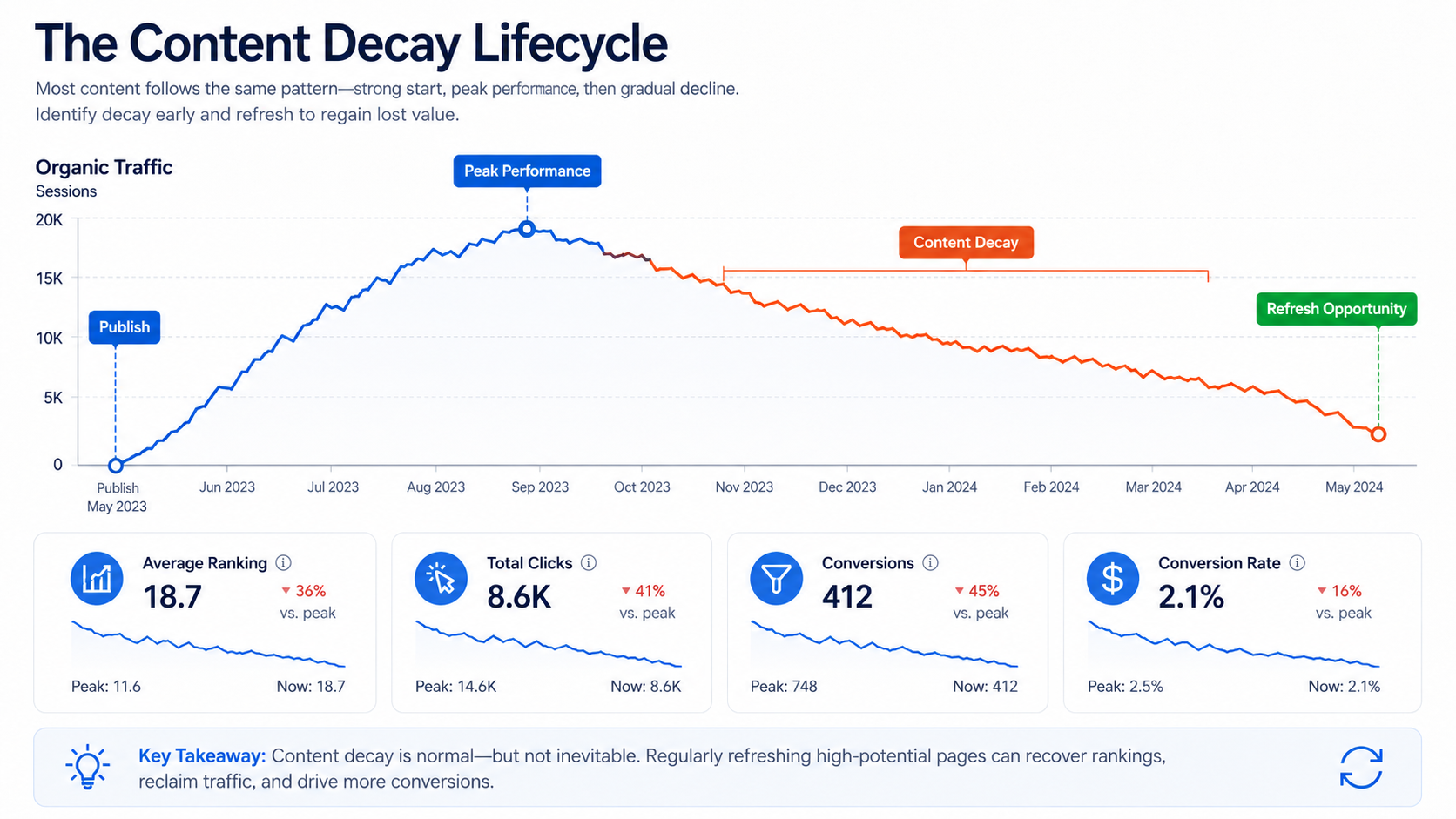 A traffic drop does not always mean the content is bad. Sometimes the keyword changed. Sometimes the search result changed. Sometimes competitors improved. Sometimes Google introduced an AI answer. Sometimes the page still gets traffic but no longer converts because the reader’s expectations have changed.
Content decay is especially dangerous because it is easy to miss.
Most companies pay attention to new content. They celebrate when a page launches. They may look at early traffic. Then they move on.
But older content is often where the hidden opportunity lives. These pages may already have backlinks, authority, age, impressions, and ranking history. They may not need to be replaced. They may need to be refreshed, expanded, reorganized, merged, or repositioned.
A good content decay review looks at questions like:
- Is the page losing traffic?
- Is the page losing rankings?
- Is the page still aligned with search intent?
- Are competitors answering the topic better?
- Does the content feel outdated?
- Are examples, screenshots, statistics, or recommendations old?
- Does the page include a clear next step?
- Is the page attracting the right audience?
- Is it still relevant to what the business sells?
That last question is important.
A page can still get traffic and be a poor business asset. If it attracts visitors who are unlikely to become customers, it may look successful in analytics while doing very little for growth.
Living Content Is the Answer to Content Decay
A lot of companies treat content like a one-time project.
They write the article.
They publish the page.
They move to the next topic.
That approach made more sense when search moved slower and competition was thinner. It does not work as well now.
Content needs to be treated more like a living asset.
Living content is content that is continually monitored and improved based on performance, search behavior, user behavior, and business goals. It is not just updated for the sake of freshness. It is improved because real data shows what is working and what is not.
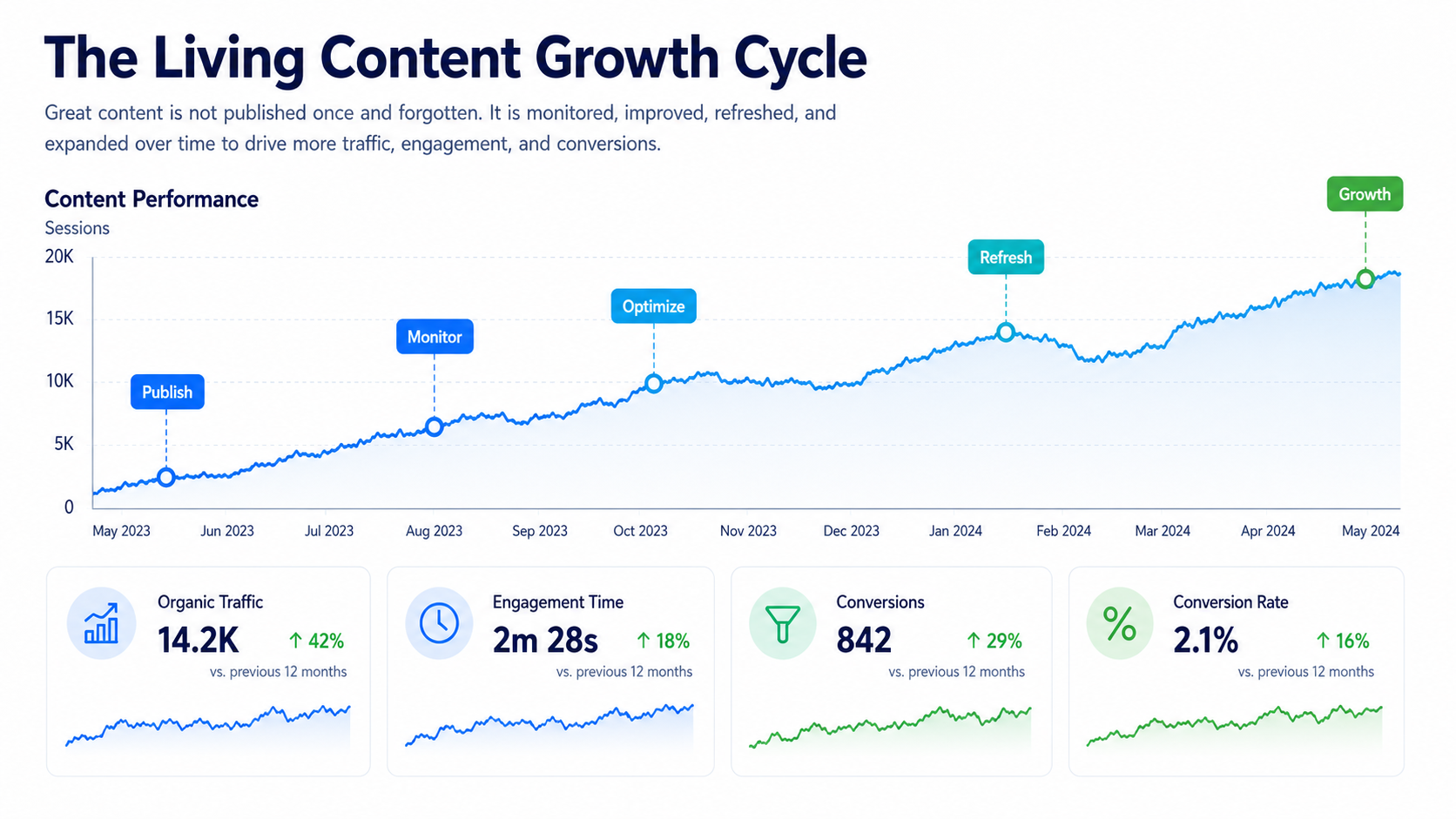 A living content process may include:
- Improving headlines based on click through rate
- Adding clearer answers to important questions
- Updating old examples or outdated statistics
- Improving internal links
- Adding video, graphics, charts, or screenshots
- Expanding thin sections
- Removing content that no longer helps
- Improving calls to action
- Rewriting confusing sections
- Adding expert perspective
- Combining competing articles
- Refreshing metadata
- Making the page more useful for AI answer engines
This is where content becomes more valuable over time instead of slowly fading.
The goal is not just to rank. The goal is to help the right person understand the problem, trust your company, and take the next step.
That means a page is never truly finished. It is either improving, holding steady, or decaying.
The SEO Problem Is Bigger Than Rankings
Traditional SEO still matters.
Technical SEO matters.
Site speed matters.
Indexability matters.
Internal links matter.
Content quality matters.
Backlinks and mentions matter.
Local visibility matters.
Structured data can matter.
Search intent matters a lot.
But the problem is that many companies are still using an older mental model of SEO.
They think SEO means picking keywords, writing pages, and trying to rank in Google.
That is part of it, but it is no longer enough.
Today, a person’s search journey may begin in one place and end somewhere completely different. Someone may discover a problem on TikTok, research it on YouTube, ask ChatGPT for options, check Reddit for opinions, compare companies on Google, read reviews, then visit your website days later.
If you only measure the final website visit, you miss most of the journey.
This creates a major measurement problem. The channels that influence the buyer may not get credit. The content that builds trust may not show a direct conversion. The AI answer that mentioned your brand may not show up in Google Analytics. The YouTube video that educated the buyer may not get connected to the form submission.
That does not mean those touchpoints are not valuable. It means the old reporting model is too narrow.
The SEO problem is not just “How do we rank higher?”
The better question is:
How do we become the trusted answer wherever our buyers are looking?
AEO, or Answer Engine Optimization, Is Now Part of the Strategy
Answer engine optimization, often called AEO, is the practice of structuring content so that answer engines can understand, trust, and cite it.
This includes Google AI Overviews, ChatGPT search, Perplexity, Bing Copilot, Gemini, and other AI powered answer tools. AEO is not a replacement for SEO. It is an expansion of SEO.
That matters because AI answers can shape how people understand your company, your industry, and your services before they ever visit your website.
If AI tools are answering questions about your industry, your services, your competitors, or your category, you want your company’s expertise to be part of the information environment those tools learn from and cite.
AEO friendly content often has several traits:
- It answers specific questions clearly
- It uses natural language
- It includes concise explanations
- It provides supporting detail
- It demonstrates expertise
- It includes examples
- It is well structured
- It connects related concepts
- It is consistent with other trusted sources
- It earns mentions and links from credible third parties
This is not about tricking AI tools. The better approach is to become legitimately useful.
That means creating content that an answer engine would want to cite because it is clear, accurate, specific, and trustworthy.
Search Everywhere Optimization Expands the Battlefield
Search everywhere optimization is the idea that people now search across many different platforms, not just Google.
That includes traditional search, social search, AI search, shopping platforms, review sites, video platforms, maps, podcasts, and online communities.
For a local service business, search everywhere may include Google, Google Business Profile, Apple Maps, Yelp, YouTube, Facebook, Instagram, Nextdoor, Reddit, and local directories.
For a B2B company, it may include Google, LinkedIn, YouTube, ChatGPT, Perplexity, review sites, industry publications, partner websites, podcasts, webinars, and comparison pages.
For ecommerce, it may include Google, Amazon, YouTube, TikTok, Reddit, Pinterest, AI shopping tools, marketplaces, and product review sites.
This changes how content should be planned.
A blog post is no longer just a blog post. It can become:
- A YouTube video
- A LinkedIn post
- A sales email
- A short social video
- A webinar talking point
- A comparison guide
- An FAQ section
- A downloadable checklist
- A Google Business Profile post
- A source for AI answer visibility
- A sales enablement asset
This is important because many businesses are still asking one channel to do too much.
They expect Google rankings to carry awareness, education, trust, comparison, and conversion. But buyers are now moving across more surfaces. Your content strategy needs to follow them.
What Businesses Should Do Before Leads Dry Up
When traffic declines, do not panic and start publishing random content.
Start with diagnosis.
Look at your analytics, search console data, rankings, conversions, and customer journey. Try to separate the symptoms from the cause.
You want to know:
- Which pages are losing traffic?
- Which pages are losing conversions?
- Which pages still get impressions but fewer clicks?
- Which queries are being affected by AI answers?
- Which pages have decayed but still have authority?
- Which pages attract traffic that does not convert?
- Which topics are missing from the buyer journey?
- Which sales questions are not answered well on the site?
- Which competitors are being cited, ranked, or mentioned more often?
Once you know that, you can make smarter decisions.
Some pages should be refreshed.
Some should be rewritten.
Some should be merged.
Some should be redirected.
Some should be expanded with video or visuals.
Some should be repositioned around a better search intent.
Some should be left alone.
Some should be removed because they no longer serve the business.
The goal is not to save every page. The goal is to build a stronger content ecosystem.
What Better Content Looks Like Now
Better content is not necessarily longer.
A 3,000 word article can still be weak if it does not say anything useful. A 900 word page can perform well if it answers the right question clearly and moves the reader forward.
Strong modern content usually does several things well.
First, it answers the main question quickly. People should not have to dig through a long introduction to understand the point.
Second, it adds depth where depth is needed. If the topic is complex, the content should explain the issue clearly, not just skim the surface.
Third, it shows real expertise. This may come through examples, opinions, original frameworks, first hand experience, case studies, screenshots, data, or practical guidance.
Fourth, it connects to the buyer journey. A helpful article should not feel like a dead end. It should naturally point readers toward the next step.
Fifth, it is structured for both humans and machines. Clear headings, direct answers, related questions, schema where appropriate, and organized sections can make the content easier for search engines and answer engines to understand.
Sixth, it gets updated. A strong article from 2021 may not be strong anymore if the market has changed, tools have changed, buyer behavior has changed, or search results have changed.
Your Website Still Matters, But Its Job Is Changing
With all this talk about AI search and search everywhere optimization, it might sound like the website is becoming less important.
That is not true.
Your website still matters. In many cases, it matters more.
But its job is changing.
Your website is no longer just a place where people land from Google. It is the central trust hub for your brand. It is where prospects confirm what they have heard elsewhere. It is where AI tools may look for clear information. It is where sales prospects go before they call. It is where your best explanations, proof, offers, and next steps should live.
The website should support the entire search ecosystem.
That means your service pages need to be clear. Your articles need to be useful. Your case studies need to prove value. Your FAQs need to answer real objections. Your about page needs to build trust. Your contact path needs to be simple. Your content needs to match what people actually care about.
If people do click through from Google, ChatGPT, LinkedIn, YouTube, or an email, the page they land on has to do its job.
Traffic is valuable, but traffic without trust does not create leads.
The New Goal Is Not Just More Traffic
For years, marketers chased traffic because traffic was easy to measure.
But more traffic is not always the best goal.
The better goal is qualified visibility that leads to trust and action.
That means your content should help your business become:
- Findable in traditional search
- Visible in AI answers
- Useful on social platforms
- Credible in third party mentions
- Clear on its own website
- Memorable to prospects
- Helpful to sales conversations
- Strong enough to convert
This is a different way of thinking.
You are not just creating content for Google. You are creating content for the whole decision journey.
That includes humans, search engines, answer engines, social algorithms, and sales conversations.
What to Do Next
If your website traffic is dropping, the answer may not be to publish more.
The answer may be to understand what is decaying, what is missing, what is outdated, and what no longer matches the way people search.
Start with your existing content.
Find the pages that used to perform well but are slipping. Look for pages with impressions but weak click through rates. Review articles that rank but do not convert. Identify important buyer questions that are missing from your website. Look at where competitors are earning visibility that you are not.
Then build a living content system.
Do not treat your best pages like old files in a drawer. Treat them like assets that need care, improvement, and measurement.
- Refresh them.
- Strengthen them.
- Clarify them.
- Add proof.
- Improve conversion paths.
- Repurpose them across platforms.
- Structure them for answer engines.
- Update them as the market changes.
Search is not disappearing. It is spreading.
People still need answers. They still need help. They still need companies they can trust.
The businesses that win will be the ones that stop thinking of content as something they publish and start thinking of it as something they continually improve.
Because in this new search environment, the strongest content does not just sit on your website.
It lives.