Marketing teams evaluating how to scale content operations keep landing on the same search: a content engineering platform that ties templates, CMS workflows, measurement, and AI visibility into one system. Most product pages describe features. Few explain what teams actually need when they are deciding between building in-house, buying software, or hiring services.
This guide is for growth leads and marketing directors who already understand what a content engineer does and now need to evaluate platforms and service partners. We cover capability criteria, build-vs-buy tradeoffs, what services should include, and how to measure whether the investment is working. For the measurement side, pair this with our content measurement framework.
What a content engineering platform is (and what it is not)
A content engineering platform is the operational layer between your CMS and your growth goals. It is not a replacement for WordPress, HubSpot, or Contentful. It is the system that standardizes how pages get built, how metadata and schema get applied, how internal links get planned, and how performance data flows back into refresh decisions.
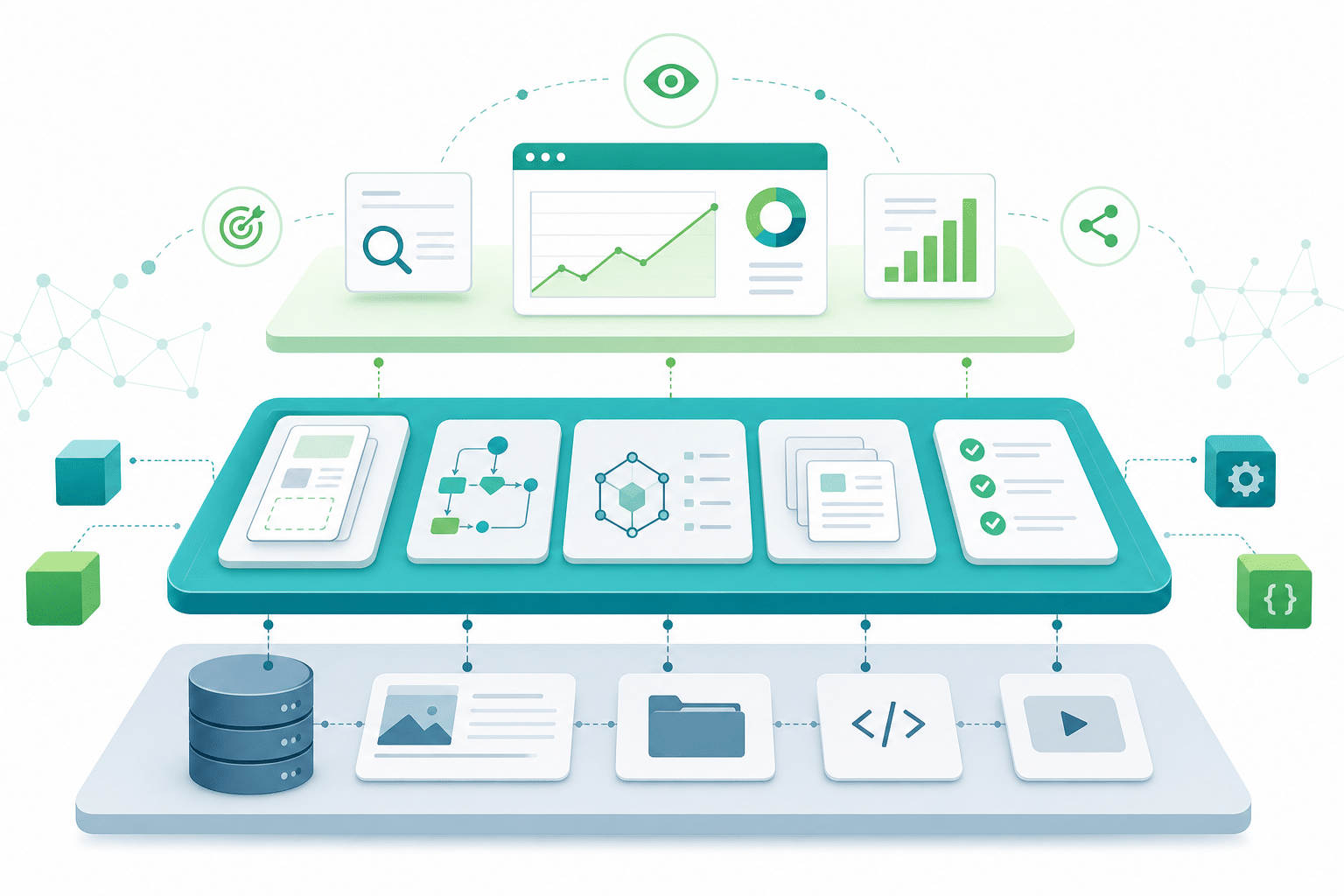
Think of three layers. At the bottom sits your CMS where drafts live. In the middle sits the engineering layer: templates, component libraries, workflow rules, and integration hooks to analytics and SEO tools. On top sits the content library itself: hubs, spokes, and living content that gets measured and updated on a schedule.
Teams that confuse a CMS with a content engineering platform often buy another SaaS seat and still manually rebuild every landing page. Teams that get it right reduce time-to-publish, cut rework on metadata, and connect publishing to a content analytics loop instead of shipping into a void.
Content engineering vs content management vs martech
These terms overlap in vendor marketing. In practice they solve different problems.
- Content management stores and publishes files. It handles roles, approvals, and versioning. It does not tell you which URLs to refresh or how to structure schema for AI citations.
- Martech spans email, ads, CRM, and automation. Useful for distribution, but most stacks treat the blog as a side channel rather than a measurable asset library.
- Content engineering designs the system that produces, connects, and maintains content at scale. Templates, information architecture, measurement hooks, and refresh workflows live here.
If your pain is “writers cannot find the right template” or “every page ships with different heading structure,” you need engineering, not another calendar tool. If your pain is “we publish constantly but traffic flatlines,” you need engineering tied to analytics, not more drafts in the CMS queue.
Build, buy, or hybrid: which path fits your team
There is no universal answer. The right model depends on headcount, CMS complexity, how often you ship, and whether search and AI visibility are core channels.
| Model | Best when | Tradeoffs |
|---|---|---|
| Build in-house | You have a dedicated content engineer or strong dev-marketing hybrid; CMS is stable; you need deep custom integrations | Slower ramp; knowledge lives in one person; maintenance competes with product roadmaps |
| Buy a platform | You want standardized templates and workflows fast; team is mostly marketers; SaaS integrations cover your stack | May not match your IA; vendor lock-in; still need someone to run the measurement loop |
| Agency / services | You need systems design plus execution; internal team is thin; you want living content ops without hiring first | Requires clear scope and handoff; quality varies; must align on measurement not just deliverables |
| Hybrid | Internal owner plus external specialists; common for B2B teams scaling from 10 to 50+ URLs per quarter | Needs explicit RACI; risk of duplicated tools if roles blur |
Most mid-size B2B teams land on hybrid: one internal owner (often a senior content or growth lead) plus either a platform subscription or a services partner for template builds, hub architecture, and analytics setup. Pure build works when content is the product. Pure buy rarely works without someone who treats the platform as infrastructure, not a magic publish button.
Core capabilities: what to require in any platform or services scope
Skip the feature dump. Score options against these four capability areas. If two or more are weak, traffic and efficiency gains stall within two quarters.
1. Templates and component governance
Reusable page types (hub, spoke, comparison, FAQ-heavy guide) with locked SEO fields, heading rules, and CTA placement. Writers choose a template; they do not rebuild layout from scratch. Component governance means one H1 rule, one schema pattern, one internal link block style across the library.
In practice, ask vendors or internal devs to show how a new spoke page gets created from template to publish in under 30 minutes including metadata. If the demo involves copying an old post and deleting half the page, you do not have engineering yet.
2. CMS and workflow integration
The platform or service must respect your CMS as source of truth. That includes draft status, author attribution, category rules, redirect handling after merges, and compatibility with your page builder (WPBakery, Gutenberg blocks, headless components). Workflow integration covers review steps, refresh tickets tied to URL lists, and optional automation for decay alerts.
3. Measurement and feedback loops
Publishing without GSC and GA4 hooks is expensive blogging. A real content engineering setup connects URLs to impression, click, engagement, and pipeline signals. Dashboards can live in Looker, Sheets, or a dedicated analytics hub. The requirement is that refresh decisions use data, not editorial whim.
Our measurement framework is a reasonable baseline for what the loop should produce: ranked URLs, issue type (decay, cannibalization, CTR gap), owner, and recheck date.
4. Search and AI visibility structure
Templates should support FAQ schema, clear definitional blocks, and internal linking patterns that help both traditional rankings and citation in AI answers. This is not a separate “AEO tool.” It is how pages are built by default.
For teams prioritizing AI surfaces, read how structure affects visibility in our guide on staying visible in search and AI answers. Platform choice should make those patterns easy to repeat, not a one-off project per post.
What content engineering services should include
When you hire for content engineering (agency, consultancy, or fractional lead), scope should read like systems work, not a pile of blog posts. Strong statements of work include:
- Information architecture audit — hub and spoke map, cannibalization review, redirect plan.
- Template and component build — documented page types with SEO and schema baked in.
- Workflow design — who publishes, who refreshes, how decay gets flagged monthly.
- Analytics wiring — GSC, GA4, and CRM or pipeline joins where possible.
- Living content cadence — tiered URLs with owners and refresh intervals.
- Knowledge transfer — runbooks so internal teams can operate after launch.
Red flags: deliverables listed only as “12 blog posts per month,” no mention of templates or measurement, or no access to Search Console during the engagement. That is content production, not content engineering.
Role clarity helps. If you need a job description for hiring internally, see our breakdown of the content engineer role and skills. Services should either fill that gap or accelerate the person you hire into the role.
Signs your team needs a platform or partner now
Not every marketing team needs to invest this quarter. These patterns suggest the current setup is costing you visibility and rework:
- Publish time is unpredictable — simple guides take days because every page is a custom layout job.
- Metadata is inconsistent — titles, schema, and internal links vary by writer; Rank Math or equivalent is an afterthought.
- Decay is invisible until traffic drops — no URL-level monitoring or refresh calendar.
- New posts stay orphaned — low impressions after 60 days because internal linking is ad hoc.
- Search and AI visibility are strategic — leadership expects organic and cited presence, but ops still run like a 2015 blog.
- Headcount is frozen — you cannot hire a full-time content engineer but need systems-level progress.
If three or more sound familiar, evaluate platforms and services in parallel. Software without an operator fails. Services without templates fail. You need at least one path that covers both structure and execution.
How to evaluate vendors without a useless features checklist
Demos flatter every product. Use these evaluation prompts instead of counting checkmarks:
- Show one hub and three spokes built from the same template family. Do they share schema, link patterns, and CTA placement?
- Walk through a refresh triggered by a decay signal. Where does the alert live? Who gets assigned?
- Export a URL list with GSC metrics from the tool or workflow. Can you sort by click loss without a manual spreadsheet?
- Publish a test page in your CMS using their template. Does it respect your categories, authors, and builder constraints?
- Ask what happens after the contract — do you own templates, documentation, and dashboards?
Weight decisions toward repeatability. A platform that cuts publish time 40% but ignores measurement will cost more in lost traffic within a year. A services partner that ships beautiful hubs without transfer docs will leave you dependent.
Common mistakes when buying or building
We see the same errors on audits regardless of industry:
Treating AI visibility as a bolt-on. Teams buy an “AEO module” but pages still ship without FAQ structure or definitional intros. Fix the template layer first.
Duplicating the CMS. Another interface that does not sync with WordPress or your headless API creates double entry. Engineering should reduce steps, not add a parallel publish path.
No owner after launch. Platforms and agencies set up systems; someone internal must run the monthly decay review. Without an owner, tools become shelfware.
Scope creep into generic content marketing. More posts without hub discipline increases cannibalization. Engineering investments should tighten the library, not only add URLs.
Ignoring redirect and merge work. Consolidation is part of engineering. If your partner never mentions redirects when combining posts, they are not thinking in systems.
Rolling out content engineering in 90 days
A practical rollout sequence for B2B teams:
- Days 1–14: Audit top 50 URLs by impressions; map hubs, spokes, and decay flags.
- Days 15–30: Finalize two or three core templates; document metadata and link rules.
- Days 31–60: Migrate or rebuild priority hubs; set GSC and GA4 reporting by URL cluster.
- Days 61–90: Run first monthly refresh cycle; measure publish time, click recovery, and internal link coverage.
Whether you build or buy, success metrics should include operational KPIs (time to publish, percent of pages using templates) and performance KPIs (clicks on refreshed URLs, reduction in cannibalized queries). Vanity post count should not be on the list.
During rollout, keep a simple decision log: URL, issue type, action taken, owner, recheck date. That log becomes the operating history your platform or partner should automate later. Teams that skip documentation in the first 90 days usually rebuild the same spreadsheets a year later.
Questions to ask before you sign
Before you commit to a platform contract or services statement of work, get written answers on these points:
- Who owns templates and documentation if the engagement ends?
- How are redirects handled when content is merged?
- Does workflow include monthly decay review, or only net-new publishing?
- Which analytics sources are required (GSC, GA4, CRM) and who maintains connectors?
- How does the system support FAQ schema and internal linking by default?
Clear answers here prevent the most common post-purchase regret: fast publishing with no maintenance loop.
Where Click Laboratory fits
We implement content engineering as a combination of systems design and living content operations: templates, hub architecture, measurement loops, and refresh cadence tied to Search Console and GA4. Some clients need a full buildout; others need a fractional engineer embedded with an internal team. The entry point is usually an audit that ranks URLs and defines what to fix before scaling publish volume.
Choose systems before you scale output
A content engineering platform or services partner should make good pages repeatable, measurable, and maintainable. If your evaluation only compares software logos or post quotas, you will end up with a faster way to publish pages that still decay in silence.
Start with capability criteria: templates, CMS integration, measurement, and search or AI-ready structure. Match build, buy, or hybrid to your headcount and how strategic organic visibility is this year. Then run a 90-day rollout with one internal owner and clear success metrics.
If you want an outside view on stack and services scope before you commit budget, we offer content engineering audits that map your library, templates, and analytics gaps to a prioritized 90-day plan.
Content engineering platform questions
Quick answers on what platforms and services cover, how to choose build vs buy, and how to measure whether your investment is working.
What is a content engineering platform?
A content engineering platform is the operational layer that sits between your CMS and your growth goals. It standardizes templates, metadata, schema, internal linking, and feedback from analytics so teams can publish and maintain content at scale without rebuilding every page from scratch.
It is not a replacement for WordPress or your headless CMS. It is how you make publishing repeatable and measurable.
How is content engineering different from content marketing?
Content marketing focuses on topics, campaigns, and audience engagement. Content engineering focuses on the systems that produce and maintain those assets: templates, information architecture, workflows, and measurement loops.
You need both. Engineering without marketing produces empty structure. Marketing without engineering produces inconsistent pages that decay quietly.
Should we build or buy a content engineering stack?
Build when you have a dedicated content engineer and need deep custom integrations. Buy when you need speed and your team is mostly marketers comfortable with SaaS workflows. Most B2B teams use a hybrid: internal owner plus platform or agency specialists.
Choose based on headcount, CMS complexity, and how central organic and AI visibility are to revenue this year.
What do content engineering services include?
Strong services cover information architecture audits, template and component builds, workflow design, analytics wiring to GSC and GA4, living content cadence, and knowledge transfer. Deliverables should include runbooks and dashboards, not only net-new articles.
If a proposal lists only monthly post counts with no template or measurement work, it is production outsourcing, not engineering.
How do you evaluate content engineering platforms?
Ask vendors to demo one hub and three spokes from the same template family, walk through a decay-triggered refresh, and publish a test page in your CMS. Check whether GSC metrics export without manual spreadsheets and whether you own templates after the contract.
Weight repeatability and measurement over feature count.
When do you need a content engineer vs an agency?
Hire a content engineer when content systems are a year-round internal function and you have enough volume to justify full-time ownership. Use agency or fractional services when you need a faster ramp, template builds, or hub architecture without a new headcount.
Many teams start with services, hire internally, then shift to hybrid with external support on audits and major migrations.
How do content engineering platforms support AI search visibility?
They encode structure that helps citations and clarity: definitional intros, FAQ schema, consistent internal links, and hub-and-spoke IA. AI visibility is a template and maintenance problem as much as a tooling problem.
Platforms should make those patterns default on every long-form page, not a custom project per URL.
How do you measure ROI on content engineering?
Track operational metrics (time to publish, percent of pages using templates, internal link coverage) and performance metrics (click recovery on refreshed URLs, reduction in cannibalized queries, pipeline influence from organic landing pages).
Compare six months before and after rollout on the same URL set rather than counting total posts shipped.