For years, businesses could gain traction in search by simply creating more helpful content than their competitors.
That playbook is breaking down.
With AI, a large competitor can now produce a massive amount of content on nearly any topic in a fraction of the time it once required. Some of it may even look polished and useful. Google allows the use of AI in content creation, but still emphasizes quality, originality, and value to people, while also warning against scaled content abuse meant to manipulate rankings.
That creates a real problem for growth-focused businesses.
If content is this easy to create now, how do you still show up in search results and AI-generated answers?
The honest answer is that most businesses are not going to win by trying to out publish larger competitors. They are far more likely to win by becoming more distinct, more useful, and more trustworthy.
That is the new game.
The real threat is not AI, it is sameness
A lot of businesses see AI content and assume the answer is simple, publish more.
That sounds reasonable until everyone does it.
When AI lowers the cost of content creation, generic content becomes even more abundant. The web fills up with pages that say roughly the same thing, follow the same structure, and repeat the same conclusions. Search engines have been explicit that content quality matters more than whether AI was involved in creating it.
This is where many companies make the wrong move. They assume the solution is volume. In reality, volume without distinction just makes you easier to ignore.
If a larger competitor has more brand recognition, more domain strength, and more resources, trying to match them page for page is usually a losing strategy.
The better strategy is to stop asking, “How can we create more content?” and start asking, “How can we create content that is more useful, more specific, and harder to replace?”
Visibility now depends on being worth citing
Search is no longer just about blue links.
Microsoft’s AI Performance reporting in Bing Webmaster Tools now shows when your content is cited in AI generated answers, which URLs are referenced, and which grounding queries are associated with those citations. That is a strong signal that visibility is increasingly about being understood and cited, not only clicked.
That shift matters.
If your content is vague, padded, or overly polished without saying anything meaningful, it becomes much harder for search engines and AI systems to rely on it.
If your content is clear, direct, structured, and grounded in real expertise, it becomes easier to surface.
This means your content should do a few things well:
- answer important questions clearly
- define terms simply
- organize ideas with useful subheads
- include examples and comparisons
- connect claims to real experience
- make it easy to understand who is behind the advice
The goal is no longer just to rank. The goal is to become a source worth referencing.
Smaller businesses still have an advantage
At first glance, AI seems to favor larger brands.
They can create more pages, build larger topic clusters, and move faster across entire categories. But smaller businesses still have something many larger competitors struggle to replicate, proximity to the real work.
Smaller teams are often closer to customers. They hear the objections on sales calls. They know what prospects misunderstand. They see where leads get stuck. They understand the patterns that come from real implementation, not just theory.
That kind of insight matters more now because AI is very good at summarizing common knowledge. It is much less powerful when the best answer depends on firsthand experience, real examples, or a clear point of view.
That creates an opening.
A large competitor may be able to create a thousand pages. They may not be able to create your actual perspective on why rankings go up while leads go down. They may not be able to explain the specific conversion issues that happen after traffic quality changes. They may not be able to publish the client patterns your team sees every week.
That is the type of content that can still stand out.
Publish information that only your business can provide
If your article could have been written by anyone, it will become harder to defend in search and AI-driven discovery.
That is why original value matters so much now.
It is so easy to mass create content. It is original content (as long as it is good) that gets the links and shows up in search and AI results.
Instead of building content around what is already obvious, build around what your business uniquely knows. That might include:
- recurring sales objections
- common mistakes buyers make
- lessons from campaign data
- patterns from implementation
- frameworks your team uses internally
- before and after observations
- practical tradeoffs most articles ignore
For example, it is easy to publish another article explaining what SEO is. It is much more valuable to publish an article on why businesses with decent rankings still fail to appear in AI-generated answers.
It is easy to explain what conversion rate optimization means. It is more useful to explain why weak messaging and poor page structure often become more damaging when AI changes the type of visitors arriving on a site.
That kind of specificity is harder to copy, and harder to replace.
It also aligns well with the way we think about search engine optimization, which is not just about producing more content, but about making content more strategic, more useful, and more commercially connected to your business.
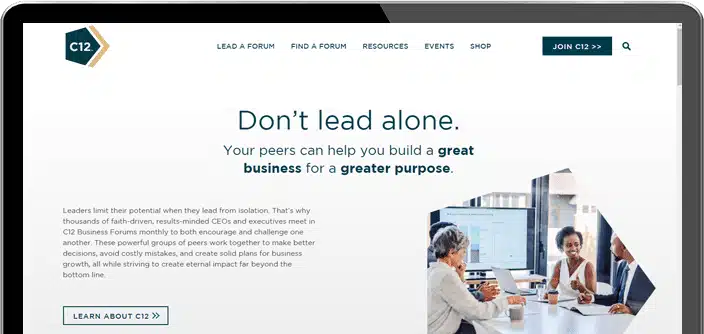
A great example of this can be seen at C12 Business Forums. Their content is totally unique. It is heavily researched and well thought out, whether it is articles, tools, ebooks or webinars. Nearly every article on their site contains:
- Uniquly designed graphics to help tell the story
- A video that enhances the content of the article
- A tool or ebook that you can download for greater research
- Links to a LOT of additional, highly relevant content to the topic
- Headlines created with the Grunt Test principles

Make your authority easier to understand
One of the biggest problems on many business websites is not a lack of knowledge. It is a lack of clarity.
Search engines and AI systems need to understand who your business is, what it does, and why it should be trusted on a topic. Google specifically says that adding organization-structured data can help it better understand your organization and disambiguate it in search results.
In practical terms, that means your site should do a better job of reinforcing your authority across key pages.
Your home page, about page, service pages, author bios, and case studies should all support the same story. A visitor, and a machine, should quickly be able to tell:
- what your company does
- who you help
- what problems you solve
- what expertise backs your advice
- how your services connect to the topics you publish about
This is one reason businesses can invest heavily in content and still remain strangely invisible. Their site reads like a collection of articles instead of the digital presence of a real expert business.
If you want to appear more often in search and AI answers, your authority cannot be implied. It needs to be made obvious.
That is also why strong web design matters more than many businesses realize. A site is not just a container for content. It is part of the trust signal itself.
Use AI as leverage, not as the strategy
AI can be incredibly useful for marketing teams.
It can help with ideation, outlining, summarizing research, repurposing material, and accelerating the drafting process. Used well, it helps a team move faster and reduce friction.
But AI should not be your content strategy.
If your strategy is simply to use AI to publish more pages than everyone else, you are building on a weak foundation. You may increase output, but you do not necessarily increase authority, trust, or conversions.
A smarter approach is to use AI to shape better source material.
Feed it your team’s experience. Feed it your customer questions. Feed it internal frameworks, campaign insights, and real examples. Then use it to organize, draft, and expand that material.
That is very different from asking AI to generate pages from thin air.
One creates momentum. The other creates noise.
Adding Internal Resources for Help Creating Content
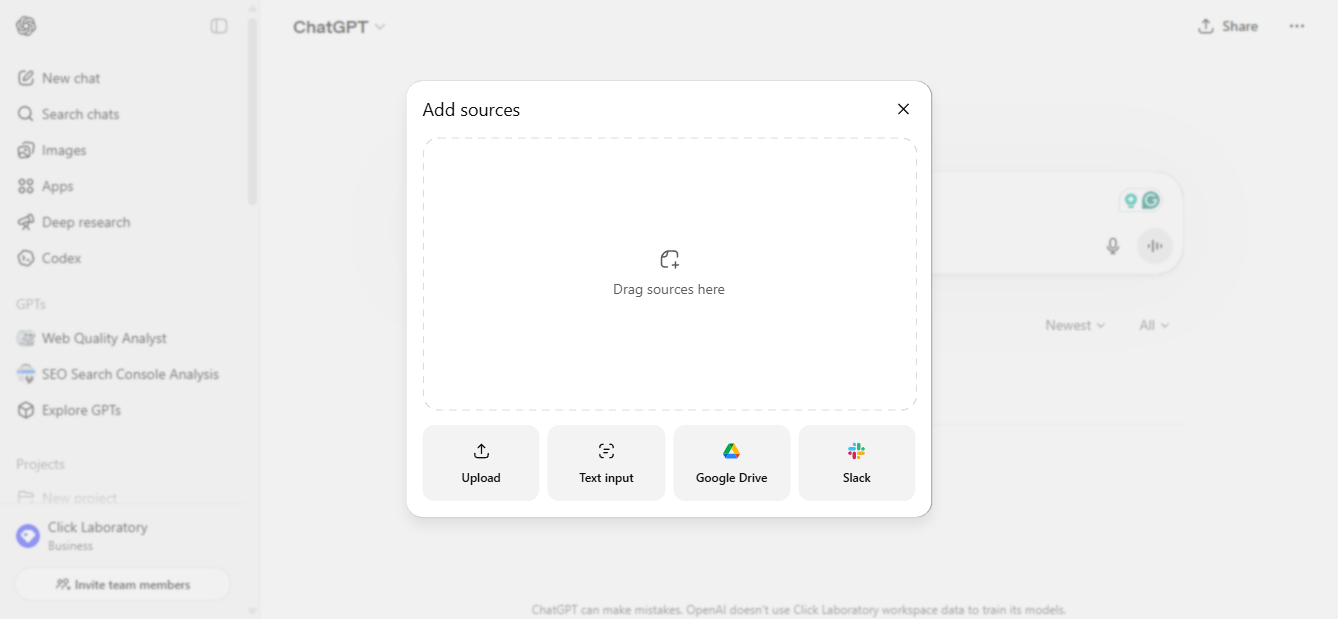
Something that can help with this is training AI on your internal documentation.
Several AI platforms have the ability to consume content from places like Google Drive or use an MCP with Cursor/Claude. Your materials can be kept private, and AI will not be publicly trained on them or give that information away in its search results. You can even use private LLMs for research, generating content ideas, or creating unique case studies.
Unique information and content that only you can produce can be a big differentiator, especially for knowledge-based companies and B2B organizations.
 Your content should support conversion, not just discovery
This is another area where many businesses get distracted.
It is easy to become so focused on visibility that you forget why visibility matters in the first place. Search traffic that does not move people toward action is less valuable than many marketers want to admit.
That is why content strategy now has to connect more directly to conversion strategy.
An example of a terrible conversion is simply pointing people to a contact page and asking them to fill it out.
If AI absorbs more top-level informational queries, then the traffic you do win needs to be more meaningful. Your pages need to help people evaluate, trust, and take the next step.
That means content should not live in isolation. It should connect to the services that solve the problem.
For example, if your article discusses how weak page structure hurts AI visibility, it makes sense to guide readers toward stronger site architecture and conversion-focused design. If your article explains why search visibility alone is not enough, it makes sense to connect that discussion to conversion rate optimization and how page experience affects lead generation.
The point is simple. Content should not just attract attention. It should help qualified visitors move closer to becoming customers.
Broaden beyond the standard blog post
A lot of businesses respond to search changes by publishing more articles.
That is only one option, and not always the best one.
If larger competitors are flooding the market with text content, one of the smartest responses is to build richer assets that they are not creating. That can include videos, visual frameworks, tools, comparison pages, calculators, and practical guides.
This is especially useful because search visibility is increasingly shaped by clarity across multiple formats. Microsoft’s guidance around AI visibility emphasizes clarity, freshness, and signals that help its systems understand your content and entities across experiences.
In other words, text still matters, but it is no longer the whole story.
The brands that stay visible are often the ones that make their expertise easier to recognize in more than one format.
Improve your best pages before creating fifty new ones
When AI changes the search landscape, the instinct is often to publish more.
But many businesses would get better results by strengthening the pages they already have, using the principles of living content.
Look first at the pages most tied to revenue, trust, and service intent. Those are the pages worth improving deeply.
- Tighten the message.
- Clarify the offer.
- Add supporting examples.
- Improve the structure.
- Strengthen internal links.
- Add real expertise.
- Make the call to action more natural.
- Update outdated sections.
This approach is less flashy than launching a huge content engine, but it is often more effective.
A smaller company can still outperform a much larger competitor when it makes an individual page more useful, more credible, and more actionable.
That is especially true when those improvements are connected to a broader system of conversion optimization, better UX, and more intentional site growth.
Accept that some traffic is changing
This part needs honesty.
Some informational traffic is likely to decline as AI systems answer broader questions directly. Google’s own documentation frames AI features as another way users may discover your site, but not necessarily in the same click pattern businesses were used to in traditional search.
That does not mean SEO is dead. It means expectations need to mature.
The goal now is not simply to win as many clicks as possible from the broadest queries. The goal is to remain visible where trust, evaluation, and action happen.
That means the businesses that adapt well will pay attention to more than traffic alone. They will care about citation visibility, branded search growth, assisted conversions, stronger engagement, and better quality leads.
This is one reason your paid media strategy, your site experience, and your organic visibility should work together rather than live in separate silos.
What businesses should do now?
If you want to stay visible in both search and AI-generated answers, here is the practical path forward.
Start with the topics where your expertise is strongest, and your commercial relevance is highest.
Then audit your existing content honestly. Ask:
- does this page say anything original?
- does it reflect real expertise?
- does it clearly connect to what our business actually does?
- is it structured clearly enough to be understood quickly?
- does it help a visitor move toward a decision?
From there, focus on depth over volume.
Strengthen your authority signals. Improve your best pages. Build around real experience. Create content that only your business could publish. Use AI to accelerate the process, but not to replace the thinking.
That is how you remain visible when content becomes easy to create.
Thoughts About Long-Term Content Creation and AI
AI is changing search, but it is also exposing a hard truth.
Many businesses never had a real content advantage. They simply benefited from a system where publishing enough decent content could still produce attention.
That system is getting weaker.
Now that content can be produced at scale by almost anyone, the businesses that win will not be the ones that publish the most. They will be the ones that publish the most useful original signals.
Do not try to out-flood the internet.
Become the source worth finding.