Executives keep asking for one number that proves AI visibility is working. That request usually collapses two different things into one chart: brand mentions and source citations. If your reporting cannot separate mentions vs citations in AI visibility reporting, you will either over-celebrate noise or underfund the pages that actually get quoted.
This guide is for marketing leaders, content ops owners, and analytics partners who need a clean reporting language for AI search. It is not another definition of AEO. It is a practical distinction you can put in a dashboard, a QBR slide, and a content prioritization meeting. We will use examples from B2B content programs and tie measurement back to content analytics decisions that already matter in Google Search Console and organic pipeline reporting.
If you already track AEO experiments, keep AEO metrics and the 90-day roadmap nearby. This post answers a narrower question: when a model names you, links you, or paraphrases you, what should the report claim?
Why mention and citation get mixed up
Most AI visibility tools scrap or simulate prompts and then score anything that looks like brand presence. That is useful for awareness monitoring. It becomes dangerous when the same score is used to justify content investment. A model can mention your brand in a list of vendors without relying on your page as evidence. A model can also cite a competitor page while describing a problem your team solves better.
Leaders hear “we showed up in AI answers” and assume the same mechanism that creates Google rankings and referral clicks. AI answers often behave more like research notes. They synthesize multiple sources, invent tidy phrasing, and only sometimes attach the source that did the dense work. Mentions can rise after a PR spike while citations stay flat. Citations can rise for one technical URL while branded mention volume stays boring.
In practice, teams mix them because both appear in one screenshot. A chat transcript shows your brand name and maybe a URL. Without a tagging rule, the analyst files it under “AI visibility uplift” and moves on. Three months later, leadership asks why pipeline did not move. The report never distinguished soft awareness from quotable authority.
Content analytics already knows this problem. Impressions are not clicks. Rankings are not revenue. Mentions are not citations. The reporting fix is the same pattern you use elsewhere: define the event, define the confidence rules, and refuse blended vanity scores when a decision needs one clean signal.
Define mention for AI visibility reporting
A mention is any AI answer, overview, or assistant response that references your brand, product, or people by name without necessarily relying on your owned URL as an attributed source. Mentions can be positive, neutral, or comparative. They can appear with or without a link. They can even appear when the model is using someone else’s content as the factual backbone.
Useful mention subtypes for operations:
- Brand name only: your company appears in a vendor shortlist
- Product name: a SKU or platform feature is named
- Person/entity: a founder, clinician, or analyst is named
- Category association: you are grouped with a problem space (“tools like X”)
Mentions matter for share of conversation and competitive awareness. They help PR and category storytelling. They are weak proof that your content asset is the thing the model trusts. If your goal is “we want our how-to pages quoted,” mention volume alone is the wrong KPI.
When you log a mention, capture prompt class, answer surface, exact phrasing, whether a URL appeared, and sentiment. Without those fields, mention reports become uncomparable week to week.
Define citation for AI visibility reporting
A citation is evidence that an AI system used or pointed to a specific source asset as support for the answer. In UI terms, that often looks like a linked source card, footnote, or “learn more” attribution that resolves to a URL. In model-behavior terms, it means your page is functioning as a reference object, not only a brand token.
Citation subtypes that keep arguments honest:
- Linked citation: clickable URL in the answer interface
- Named source citation: publisher or page title shown as evidence even if the UI is capped
- Paraphrase + URL corroboration: distinctive wording from your page paired with your URL in the same answer
- Cross-surface citation: the same URL appears across multiple AI products for the same prompt set
Citations are closer to content analytics outcomes. They tell you whether definitions, frameworks, original data, or process pages are portable into AI answers. That is why pages optimized for content analytics for AEO and AI search usually measure citations separately from brand chatter.
Be strict. If the model restates a public fact everyone uses and also happens to say your brand once, that is not automatic evidence of citation. Require a source attachment or a unique content match.
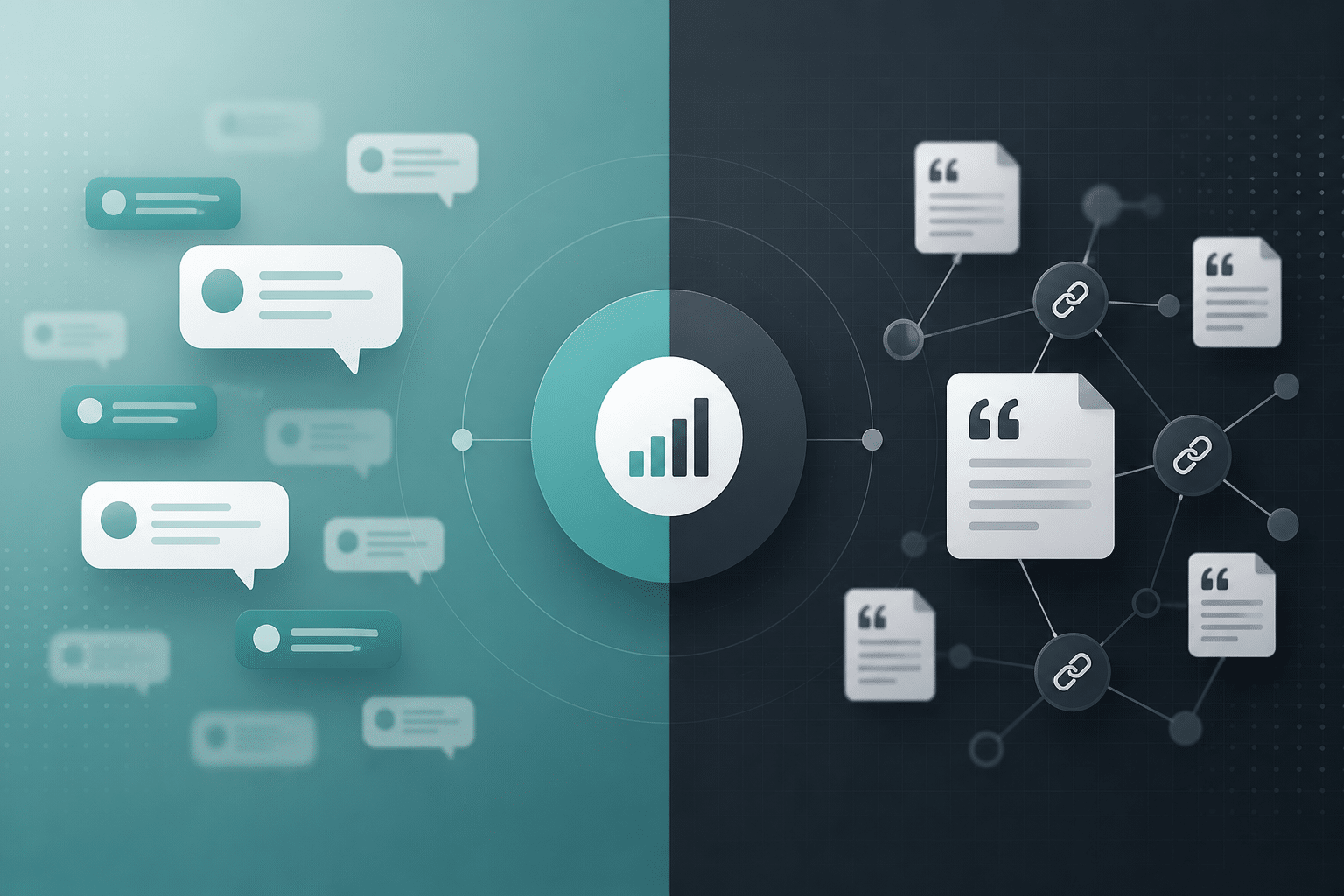
Side-by-side: mentions vs citations
Use this table in reporting documentation and onboarding for analysts.
- Signal type: mention = brand presence; citation = source use
- Typical evidence: mention = name string; citation = URL/source card
- Best owner: mention = brand/PR + category; citation = content + SEO/AEO
- Decision it supports: mention = awareness and competitive narrative; citation = which URLs to refresh, expand, or protect
- False confidence risk: mention score rising while your pages are not the evidence; citation without traffic still possible, but at least the content asset is in play
When a dashboard blurs these, leadership naturally asks for one KPI. Give them two lines instead: “Brand mentions in AI answers” and “Owned-URL citations in AI answers.” Then add a third line only if you have traffic or assisted conversions tagged from AI referrers.
Why mention-only dashboards create false confidence
Mention-only dashboards feel rewarding because they move. A single media cycle can create dozens of soft mentions. Competitive categories also force models to list several vendors. Your brand can enter that list through third-party roundups and review sites that have little to do with your editorial quality.
False confidence shows up in four ways:
- Teams pause technical content refresh because “AI visibility is up.”
- Budget shifts from source-worthy assets to more PR without measuring citation share.
- Product pages stay thin while blog fluff gets mentions from brand adjectives.
- Pipeline conversations stall because nobody can point to cited URLs that influenced research journeys.
This is the AI-era version of celebrating impressions while ignoring CTR. For the classic search version of that trap, keep why website traffic is dropping in your internal link set when reports mix vanity and outcomes. The lesson is transferable: measurement definitions decide strategy.
How to tag mention events and citation events
Create a lightweight taxonomy before you buy another platform. A simple spreadsheet or warehouse table is enough for a pilot.
Minimum fields per observation:
- Date and AI surface (ChatGPT, Perplexity, Google AI Overview, Gemini, Copilot, etc.)
- Prompt class (definition, comparison, how-to, best-of, local, product)
- Brand mention present? (yes/no)
- Owned URL cited? (yes/no + URL)
- Third-party URL cited? (yes/no + domain)
- Match quality (exact quote, close paraphrase, weak overlap)
- Commercial intent of prompt (low/medium/high)
- Screenshot or transcript ID
Analysts should label an event as mention-only, citation-only, both, or neither. Both is common and still useful. Neither is common when you are prompting brand-adjacent categories and learning what evidence models prefer.
Run a weekly sample with fixed prompt sets so growth is not an artifact of whoever remembered to ask nicer questions. Rotate challenger prompts monthly, but keep a core set stable for trend lines.
Reporting pack for executives
Executives do not need twenty AI vanity metrics. They need a pack that survives awkward questions in a leadership meeting.
Recommended slide stack:
- Mentions: total branded mentions, share vs 2–3 named competitors, sentiment mix
- Citations: owned URL citation count, unique URLs cited, citation concentration (top 5 pages)
- Coverage: prompt classes where you are invisible despite business importance
- Content action: which URLs to refresh, merge, or create next based on citation gaps
- Business bridge: AI-referred sessions, assisted demo requests, or influenced opportunities when tracking exists
If you cannot yet bridge to pipeline cleanly, say so. Pair visibility work with tying AI visibility to pipeline and revenue rather than inventing a fake ROI formula. Credibility beats creative math.
Keep titles and intros decision-oriented. “Mentions vs citations: which KPI to trust this quarter” will outperform “AI visibility report overview.” Your GSC CTR lessons already show that outcome framing gets the click; the same applies inside Slack when people decide what to open.
Content decisions that change when you separate the metrics
Once mentions and citations are split, editorial priorities change.
If mentions rise and citations stay flat, invest in source-worthy assets: original definitions, decision trees, proprietary benchmarks, comparison tables with transparent methods, and service explainers that answer operator questions. Soft brand posts and recycled thought leadership rarely become citations.
If citations rise for old deep guides while new posts get zero, protect and refresh the cited URLs. That is a living-content job, not a net-new topic race. Update examples, tighten intros, and strengthen internal links from related spokes.
If competitors earn citations with third-party review domains, your gap may be distribution and corroboration, not only onsite copy. Mentions on review sites can feed brand presence while your owned pages remain the long-term citation target.
If product intent prompts never cite your product pages, fix product content structure: specs, use cases, integration notes, and objection handling written as quotable blocks. Blog essays will not rescue a thin product URL in that prompt class.
Workflow: weekly mentions vs citations review
Use a 45-minute weekly ritual for AEO + content analytics owners.
- Run the fixed prompt sample across priority surfaces.
- Tag each transcript with mention/citation fields.
- Update two charts: mention trend and citation trend.
- List the top cited owned URLs and the top missed prompt classes.
- Assign one refresh, one support asset, or one consolidation decision.
- Log whether last week’s action changed next week’s citations.
This keeps AI visibility work inside content operations instead of a side theater. It also prevents the team from chasing every new AI tool feature while the same uncited pages remain thin.
For teams already mature on decay and refresh ops, bolt this onto your existing monitoring cadence rather than inventing a parallel program. AI citation gaps often map to the same URLs that already show soft Google CTR or aging statistics.
Common objections from stakeholders
“Mentions are good enough; brand awareness moves deals.” Awareness can help. It still does not tell you which pages to fund. Keep mention reporting, but do not let it choose URL priorities alone.
“Citations are unstable across tools.” True. That is why you track prompt sets and surfaces separately, and why you look for repeated citations across weeks, not one-off screenshots.
“We cannot prove revenue.” Then report leading indicators honestly: citation breadth, prompt coverage, AI-referred sessions, assisted form starts. Overclaiming kills trust faster than under-claiming.
“Our tool already scores visibility.” Ask whether the score blends mention and citation. If yes, extract the components or run a parallel tagged sample. Blended scores are fine as headlines only when the footnotes stay honest.
Implementation checklist for your next QBR
- Write one-sentence definitions for mention and citation approved by marketing ops
- Create a tagging sheet with the minimum fields above
- Pick 25–50 recurring prompts tied to revenue topics
- Report mentions and citations as separate lines for 8 weeks
- Map citations to owned URLs and owners in the CMS
- Pick three content actions from citation gaps, not from mention vanity
- Connect whatever AI referral data you have without overstating causality
Teams that finish this checklist usually stop arguing about whether AI search “matters.” They start arguing about which URL deserves the next refresh engineer hour. That is a healthier fight.
Where Click Laboratory fits
If you need help building the measurement layer and the content decisions that follow it, start with a consultation on AI visibility reporting and content analytics. The outcome should be a reporting language your executives trust and a prioritized URL list your team can execute. Mentions tell you whether the market talks about you. Citations tell you whether AI systems lean on your assets. You need both numbers, labeled correctly, before you call the program a win.
Prompt classes where the distinction matters most
Not every prompt class produces useful mention or citation data. Weight your sample toward commercial and operator questions.
Definition prompts (“What is content decay?”) are citation heavy when a page owns a crisp definition block. Mentions alone are rare unless your brand name is embedded in the term.
Comparison prompts (“X vs Y for mid-market B2B”) produce many mentions and fewer owned citations. Models love tidy vendor lists. If your comparison page has a transparent methodology and updated criteria table, it can still earn citation; if it is opinion fluff, you may only get a mention through third-party roundups.
How-to prompts are where citations pay rent. Operators ask for workflows, checklists, and decision trees. Unique process pages with numbered steps and failure modes get quoted. Generic motivational posts get ignored.
Best-of prompts are mention factories. Treat them as brand monitoring, not content ROI proof, unless your research study is the cited evidence behind the list.
Product prompts should cite product docs, integration pages, and implementation guides. If those URLs never appear while blog posts do, your information architecture is teaching models the wrong primary source.
Build your weekly sample so that at least half the prompts are how-to or product-intent. That keeps the citation metric decision-relevant.
Examples of good and bad score interpretations
Good interpretation: Mentions up 40% after a conference, citations flat. Action: PR win noted; content team continues refresh on the three URLs that already earn citations in how-to prompts.
Bad interpretation: Mentions up 40%, so AI content strategy is working and we pause technical refreshes. That converts a PR spike into an editorial holiday.
Good interpretation: Citations concentrated on two aging guides. Action: refresh those guides, add supporting spokes, and internal-link from new posts rather than publishing five near-duplicate definitions.
Bad interpretation: Citations concentrated on two aging guides, so we need twenty new posts in the same cluster this month. That increases cannibalization risk without improving the assets models already trust.
Good interpretation: Competitor citations come from a benchmark report host on a partner domain. Action: plan a first-party study or strengthen corroborating assets; do not only rewrite homepage adjectives.
Write these examples into your reporting playbook so new analysts do not invent optimistic stories under deadline pressure.
Instrumenting AI referral clues without overclaiming
Some teams see referral traffic, assistant parameters, or branded search lift after citation gains. Those clues help. They are not clean multi-touch attribution by themselves. Tag what you can in analytics, annotate campaigns and launches, and use directionality language in QBRs.
When you present mentions vs citations next to business metrics, keep the causal verbs careful: “accompanied,” “correlated,” “consistent with,” not “caused,” unless you ran a controlled experiment. AEO work can still be strategic without pretending every cited URL has a known revenue coefficient.
If leadership demands a single KPI, give them “owned URL citations on revenue prompt classes” as the primary, with mentions as a secondary brand monitor. That compromise preserves accountability without deleting awareness reporting.
Need help separating AI visibility metrics?
If your team is blending mentions and citations into one slide, we can help you build a cleaner reporting pack and the content actions that follow from citation gaps.
Mentions vs citations FAQs
Use these answers when stakeholders ask why AI visibility went up but content performance still feels unclear. The goal is a shared vocabulary for reporting, not a new vanity score.
What is the difference between mentions and citations in AI visibility?
A mention is when an AI answer references your brand, product, or people by name. A citation is when the system uses or points to a specific source asset, usually with a URL or source card. Mentions track conversation presence. Citations track whether your content is acting as evidence. Both can appear in the same answer, but they support different decisions. Brand teams care about mentions. Content and AEO teams should prioritize citations when choosing which URLs to refresh or protect.
If your dashboard blends them into one visibility score, ask for the components. Otherwise you will celebrate PR-driven namechecks while source-worthy pages stay weak.
Why can mention-only AI dashboards mislead executives?
Mention volume moves for reasons that may have little to do with content quality: news cycles, roundup lists, affiliate posts, and category comparisons. Executives see a rising line and assume owned pages are earning trust inside AI answers. That false confidence delays refreshes, misallocates budget, and makes pipeline conversations harder because nobody can point to cited assets that influenced research.
Keep mentions for awareness monitoring. Use owned-URL citations for editorial priority. Report them as separate lines so the story stays honest under questioning.
How should we tag mentions vs citations each week?
Use a fixed prompt sample and a simple schema: date, AI surface, prompt class, mention yes/no, owned URL cited yes/no, third-party domains cited, match quality, and commercial intent. Label each observation as mention-only, citation-only, both, or neither. Keep a stable core prompt set for trends and rotate challenger prompts monthly.
Screenshots or transcript IDs matter for auditability. Without them, weekly debates become opinion contests instead of measurement reviews.
Which KPI should lead an AI visibility QBR?
Lead with owned URL citations on revenue-relevant prompt classes. That metric maps to content assets you control. Keep brand mentions as a secondary monitor for share of conversation. Add business bridge metrics only when you have AI-referred sessions or assisted conversions you can defend.
If leadership wants one number, do not invent a blended vanity index. Choose the citation KPI and show mentions in a footnote chart.
Do citations guarantee traffic or pipeline?
No. A cited page can influence research without producing a clean last-click session. Treat citations as a leading content authority signal. Pair them with referral clues and opportunity notes when available, and use careful language about correlation versus causation. Overclaiming ROI from sparse AI attribution data damages trust faster than admitting measurement limits.
The practical win is better URL prioritization even before attribution is perfect.
What content should we create if citations stay flat?
Build source-worthy assets: quotable definitions, decision trees, proprietary data, transparent comparison methods, and operator how-to pages. Refresh aging URLs that already earn occasional citations instead of only publishing near-duplicate thought leadership. Fix thin product and integration pages if product-intent prompts never cite you.
Mentions can still rise from PR while this work is unfinished. Do not let that distract the content roadmap.
How does this relate to Google Search Console metrics?
The pattern is familiar. Impressions are not clicks, and mentions are not citations. GSC still matters for discovery and CTR diagnosis, while AI citation tracking answers whether models lean on your assets after synthesis. Use both systems. Do not replace search analytics with an AI vanity score, and do not ignore AI answers because GSC still exists.
Teams that already practice content analytics for decay and refresh can extend the same operating cadence to citation monitoring.