There is no shortage of opinions about AI-generated content and the platforms that will do it for you.
I’ll admit, we’ve had customers over the last few years ask us to simply generate new blog posts using AI. So we’ve used a wide range of the top AI content generation platforms out there. But at the end of the day, we didn’t see the SEO needle make any movement.
Don’t get me wrong, the content seemed to be good, but it just didn’t deliver.
Some marketers believe AI lets you scale SEO faster than ever. Others are convinced Google will eventually punish websites for using it. And plenty of companies have taken the simplest possible approach: produce as much content as possible and hope something sticks.
We wanted a better answer.
So instead of debating whether AI content works, we decided to test it. Over a period of roughly two months, we created 224 new AI-assisted pages across five very different websites:
- A Weight Loss Clinic
- A Cardiovascular Medical Practice
- A General Medical Practice
- A Startup SaaS Company (we are talking a brand new website here from scratch)
- A Software Agency
These are not big sites, nor do they have huge traffic numbers. We wanted to see what happened for the average website.
The sites serve different audiences, operate in different industries, and started with very different levels of search visibility.
That made the experiment much more useful. If one site improved, it could simply be a lucky topic or an existing strength of the domain. And importantly, we looked at the most recent 28 days compared with the preceding 28 days.
That last comparison matters because SEO does not move in a perfectly straight line. A longer before and after comparison can sometimes hide what is happening right now. If similar patterns appeared across several unrelated websites, we would have something much more interesting to study.
We pulled approximately 12 months of Google Search Console data for the five sites and compared what happened before and after the content generation programs began.
The results were encouraging.
But they were also much more complicated than simply saying, “AI content works.”
First, the headline numbers
Across the four websites, we published:
224 new pages
Those pages generated:
502,548 Google Search impressions
and
2,249 organic search clicks from Google
within the 2-month test period.
That alone is noteworthy.
Of the 224 pages:
125 are averaging a Google position of 10 or better.
189 are averaging a position of 20 or better.
In other words, about 56% of the new pages are already averaging a first page position, based on Google Search Console’s average position metric.
About 84% are averaging within the top 20.
That does not mean every page is a success.
Far from it.
Only 104 of the 224 pages had generated at least one click at the time of the analysis. That difference between rankings, impressions, and actual clicks became one of the most important things we learned.
The results were not the same on every site
Here is the basic picture (Strictly Google Organic Traffic).
| Site | Clicks Before AI Program | Clicks After AI Program | Change in Clicks | Change in Impressions | Clicks Directly From New AI Pages | AI Pages as % of Post Period Clicks | Most Recent 28 Day Click Trend |
|---|---|---|---|---|---|---|---|
| Weight Loss | 1,782 | 2,775 | +55.7% | +31.1% | 520 | 18.7% | +59% |
| Cardiologist | 5,808 | 6,382 | +9.9% | -20.3%* | 1,382 | 21.7% | +67% |
| General Practice | 1,023 | 1,564 | +52.9% | +7.6% | 225 | 14.4% | +63% |
| Click Laboratory | 282 | 335 | +18.8% | +73.3% | 122 | 36.4% | +7% |
| Combined | 8,895 | 11,056 | +24.3% | — | 2,249 | 20.3% | +62% |
* The cardiologist’s impressions declined into June after an extremely strong February through April, but then reversed sharply. Its most recent 28 days showed impressions up about 57% and clicks up about 67% versus the preceding 28 days.
Across the four sites, organic clicks increased 24.3% after the AI content programs began. The 224 new pages directly generated 2,249 clicks, accounting for virtually all of the portfolio’s net increase in organic traffic during the comparable periods.
Recent performance is accelerating. In the most recent 28 days of the dataset, combined organic clicks across the four sites were approximately 62% higher than the preceding 28 days, while impressions were approximately 65% higher.
Across all four websites, organic clicks increased from:
8,895 clicks before the programs
to
11,056 clicks after the programs
That is an increase of:
24.3%
The 224 new pages themselves generated 2,249 clicks.
Here is where the math gets particularly interesting. If we subtract those 2,249 clicks from the post program total, the remaining portions of the websites generated approximately:
8,807 clicks
Before the programs began, those sites generated:
8,895 clicks
That is almost perfectly flat.
So mathematically, the traffic generated by the new pages accounts for virtually all of the net increase in organic clicks across the four sites. That does not mean every other page was unaffected by the content program. Some existing pages gained traffic, while others lost traffic. But it does tell us something important.
The growth was not simply coming from websites that were already growing. The new content represented a substantial new source of organic traffic.
The most recent data may be even more interesting
The before and after comparison gives us a useful long view. But we also wanted to know what is happening right now.
So we compared the most recent 28 days in the dataset with the previous 28 days.
Across all four websites combined:
Organic clicks increased approximately 62%.
Google Search impressions increased approximately 65%.
That recent acceleration appears on all four sites, although the magnitude varies considerably. This matters because some of the sites declined during the early part of the content program before beginning to move upward.
The Cardiologist is the best example.
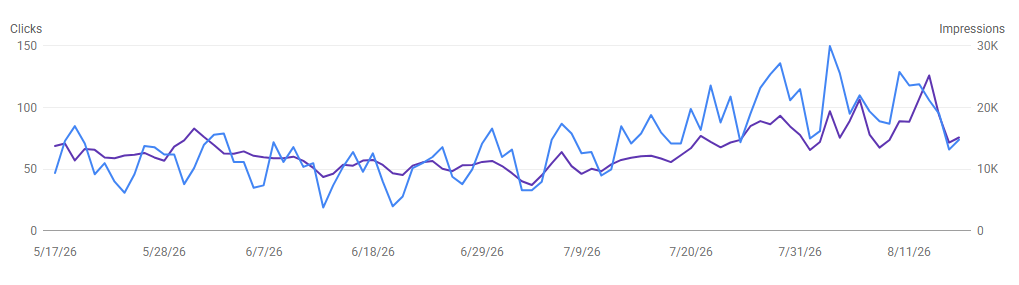
Cardiologist: The current trend is unmistakably upward
The Cardiologist produced the strongest direct performance from the new content.
Cardiologist: The current trend is unmistakably upward
The Cardiologist produced the strongest direct performance from the new content.
Its 60 new pages generated:
257,264 impressions
and
1,382 organic clicks
The new pages account for approximately 22% of all organic clicks during the post program comparison period.
The ranking performance is also strong. Of the 60 pages:
43 are averaging position 10 or better.
56 are averaging within the top 20.
That means more than 70% of the new content is already averaging a first-page position.
More than 93% is averaging within the top 20. More importantly, the traffic is not coming from one article. Several pages became meaningful organic traffic sources very quickly.
- An article about high heart rate and sweating at rest generated 294 clicks.
- An article about heart palpitations that wake you up generated 173 clicks.
- A comparison of AFib and PVCs generated 143 clicks.
- An article explaining how POTS is diagnosed generated 131 clicks.
- A page about fast heart rate and nausea generated 96 clicks.
The five best pages account for about 61% of the new content’s clicks. That is still concentrated, but significantly less concentrated than what we saw on some of the other websites.
The Cardiologist is developing a much broader portfolio of pages that are producing traffic.
The Cardiologist also taught us why SEO data needs context
If we only compare the entire 89 day period after the program began with the preceding 89 days, impressions appear to have fallen.
The earlier period generated approximately:
1.45 million impressions
The period after the program began generated approximately:
1.16 million impressions
That is a decline of about 20%.
At first glance, you might conclude that search visibility was deteriorating. But that is not what the current trend shows. The site had exceptionally strong impressions during February, March, and April, then declined into June.
Average daily impressions looked like this:
April: 16,052
May: 13,938
June: 11,230
Then the direction changed.
July: 12,609
August 1 through August 15: 17,367
The click trend is even stronger.
June: 53.5 clicks per day
July: 80.9 clicks per day
August 1 through August 15: 103 clicks per day
The site did experience a decline.
But it is no longer declining. It reached its low point around June and has since reversed direction sharply. When we compare the most recent 28 days with the preceding 28 days:
Clicks increased approximately 67%.
Impressions increased approximately 57%.
That tells a very different story. We cannot prove that the AI content program caused the entire recovery. Search performance is affected by too many variables to make that claim based on Search Console alone.
What we can prove is that the new pages are contributing materially to the recovery.
They have already generated more than a quarter million impressions and nearly 1,400 clicks. And 43 of the 60 are averaging first page positions.
That is a strong result.
The Cardiologist also gives us a clue about what content works
Look at the topics generating traffic.
They are not generic articles like:
“What Is Heart Disease?”
They are specific questions people might actually have when something feels wrong.
- Why is my heart racing and I am sweating while sitting still?
- Why do my heart palpitations wake me up?
- How can I tell the difference between AFib and PVCs?
- Can a fast heart rate cause nausea?
- How is POTS actually diagnosed?
These are the types of questions someone searches because they genuinely want an answer.
The Cardiologist also has legitimate medical expertise surrounding these topics.
That combination appears to matter.
Weight Loss Clinic: A five-month decline reversed
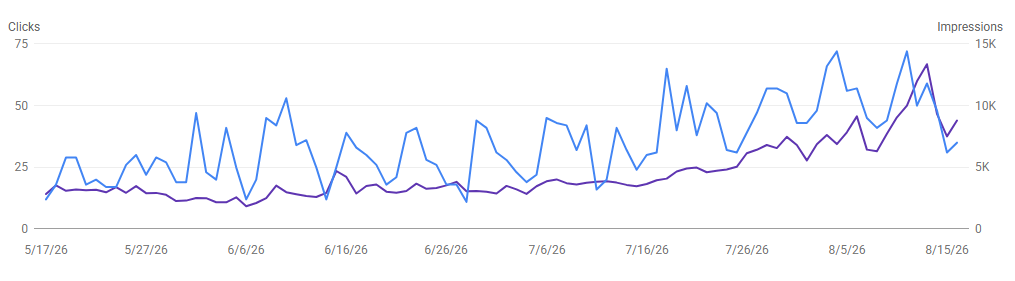
The Weight Loss Clinic may have the clearest turnaround pattern. Before the AI content program began, organic clicks had been declining for months.
Weight Loss Clinic: A five-month decline reversed
The Weight Loss Clinic may have the clearest turnaround pattern. Before the AI content program began, organic clicks had been declining for months.
Average daily clicks looked like this:
January: 45.3
February: 34.8
March: 28.9
April: 24.7
May: 22.6
That is a fairly consistent downward trend.
The AI content program began in early June. During the 73 days immediately before the program, the Weight Loss Clinic generated:
1,782 clicks
and
265,560 impressions
During the next 73 days:
2,775 clicks
and
348,064 impressions
That represents:
55.7% more clicks
and
31.1% more impressions
The 49 new AI-assisted pages directly generated:
520 clicks
and
117,266 impressions
Approximately 19% of all organic clicks during the post program comparison period went directly to those new pages. And again, the recent trend is stronger than the full period comparison suggests.
Average daily clicks went from:
June: 29.8
to
July: 38.1
to
August through the 15th: 52.7
Average daily impressions increased from:
June: 3,021
to
July: 4,484
to
August through the 15th: 8,375
That is a dramatic shift from where the site was headed earlier in the year.
When we compare the latest 28 days with the previous 28:
Clicks increased approximately 59%.
Impressions increased approximately 104%.
Average daily impressions more than doubled.
The new Weight Loss Clinic pages are also ranking
Of the 49 new pages:
20 average a position of 10 or better.
35 average within the top 20.
Twenty-seven have already generated at least one organic click. The strongest articles again tell us something about topic selection. An article about eating badly on the weekend generated 106 clicks.
- A page asking whether a 10 pound weight loss is noticeable generated 98 clicks and more than 24,000 impressions.
- An intermittent fasting workout schedule generated 78 clicks and more than 17,000 impressions.
- An article about why someone always leaves one bite of food generated 79 clicks.
These are specific questions.
They are not broad attempts to rank for “weight loss.”
That distinction appears to matter.
But the Weight Loss Clinic also shows why we cannot just count pages
The five highest traffic pages account for approximately 77% of all clicks generated by the 49 new pages.
Some articles are working exceptionally well.
Others have done very little. That is not necessarily a failure. It is data.
Instead of expecting every article to perform equally, we can use the first wave of content to discover what Google and users respond to.
Then the next wave becomes smarter.
General Medical Practice: Strong growth and accelerating momentum
The General Medical Practice shows another variation of the same story.
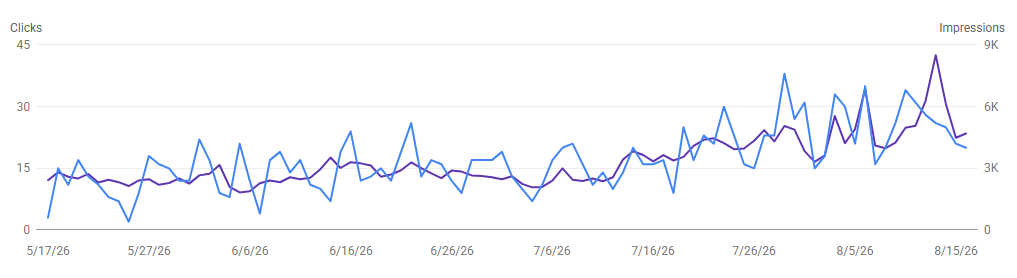
During the 90 days immediately before its AI content program:
1,023 organic clicks
277,137 impressions
During the following 90 days:
1,564 clicks
298,119 impressions
That represents:
52.9% growth in clicks
and
7.6% growth in impressions
The 62 new pages directly generated:
225 clicks
and
51,285 impressions
Approximately 14% of post program organic clicks came directly from the new content.
But the General Medical Practice has another encouraging characteristic.
If we subtract the new content traffic, the rest of the website still generated about:
1,339 clicks
That compares with 1,023 during the previous period.
So clicks to the rest of the site increased approximately:
31%.
We cannot say the new content caused that increase.
It may have contributed to broader topical authority. It could also be influenced by other SEO work, changes in search demand, local visibility, Google updates, or other factors. But the site was not simply being carried by the new pages.
Both the new content and the rest of the website were generating more clicks.
The General Medical Practice is accelerating now too
Average daily clicks increased from:
June: 14.9
to
July: 18.5
to
August through the 15th: 25.3
Average daily impressions increased from:
June: 2,716
to
July: 3,431
to
August through the 15th: 5,087
The most recent 28 days compared with the preceding 28 show:
Clicks up approximately 63%.
Impressions up approximately 68%.
That is significant current momentum.
Nearly half the new pages are averaging page one
Of the 62 new pages:
29 average position 10 or better.
49 average within the top 20.
Twenty-seven have generated clicks so far.
But once again, the winners are highly concentrated.
One article about whether sleeping on your side can cause acne generated:
77 clicks
and
16,028 impressions
Another discussing the best sleeping position for acne-prone skin generated:
62 clicks
and
10,564 impressions
Those two articles alone account for roughly 62% of all clicks generated by the new content.
This is exactly why we should not look at this experiment and conclude that the answer is simply “publish more.”
The answer is to understand why those two topics worked.
Software Agency: Visibility is growing much faster than traffic
The Software Agency produced the most complicated result. Where the other sites were locally focused, the agency is nationally focused and in an extremly competitive SEO space with very large players.
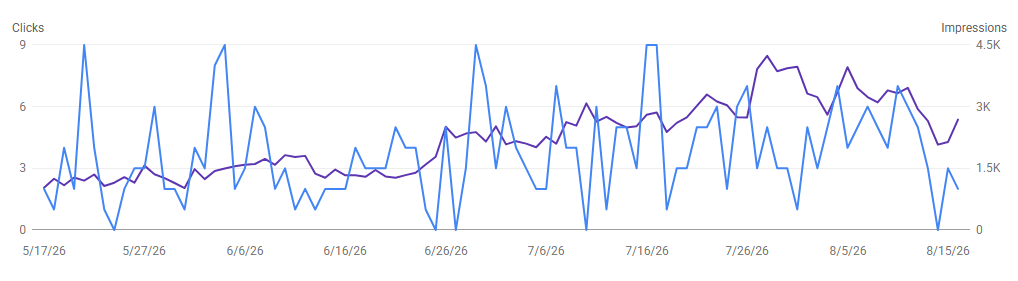
During the 88-day period before the AI content program:
282 organic clicks
and
114,224 impressions
During the following 88 days:
335 clicks
and
197,985 impressions
That means:
Clicks increased 18.8%.
Impressions increased 73.3%.
The 53 new AI-assisted pages generated:
76,733 impressions
and
122 clicks
Those pages represented roughly:
39% of post program impressions
and
36% of post program clicks
The ranking numbers look strong too.
Of 53 new pages:
33 average position 10 or better.
49 average within the top 20.
On paper, that sounds fantastic.
But there is a problem.
Only 14 of the 53 pages have generated a click.
Thirty-nine have generated zero.
That creates a very important question:
How can so many pages rank reasonably well and generate substantial impressions without generating clicks?
One article is carrying most of the Software Agency traffic
An article about vibe coding generated:
94 clicks
and more than
22,000 impressions
Those 94 clicks represent approximately 77% of all clicks generated by the 53 new pages.
Remove that article, and the other 52 pages combined generated only:
28 clicks
That is not something we should hide behind a big impression number.
It is something we need to understand and improve.
The visibility trend is still moving in the right direction
The Software Agency’s impressions have been growing quickly.
Average daily impressions were:
June: 1,631
July: 2,831
August through the 15th: 3,097
When we compare the most recent 28 days with the preceding 28:
Impressions increased approximately 41%.
Clicks increased only about:
7%.
That gap is the story.
Google is increasingly showing the content. Users are not clicking at anywhere near the same rate. Some individual pages make this even more obvious.
One article about performance metrics generated more than 10,000 impressions while averaging a position around five, but received only two clicks.
Another article about AI coding generated more than 19,000 impressions, but only three clicks.
This tells us that simply getting into search results is no longer enough.
Rankings are not the same thing as SEO success
One of the biggest lessons from this experiment is that traditional SEO metrics can easily mislead you.
A page can have:
- Thousands of impressions.
- An average first page position.
- Dozens of ranking queries.
- And almost no traffic.
That sounds strange until you consider how modern Google results work.
- A user may receive an answer directly from an AI Overview.
- The search result might contain maps, videos, images, featured results, Reddit threads, or other elements that receive the click first.
- Google may be testing your page for searches that are only loosely related to what the user actually wants.
- Your title may technically answer the query but fail to give someone a reason to click.
- Or the query itself may simply have low click potential.
That is why impressions and average position cannot be the end of SEO reporting.
We need to ask what happened next.
- Did someone click?
- Did they engage with the page?
- Did they continue through the website?
- Did they convert?
There is another reason average position can be misleading
Adding a large amount of content can actually make a site’s overall average position look worse while the site becomes healthier.
Why?
Because new content introduces the website to thousands of new queries. A website that previously ranked for 1,000 searches may suddenly start appearing for thousands more. Some of those new rankings might begin at position 15, 30, or 50. That can pull down the website’s average position while simultaneously increasing visibility and clicks.
For that reason, we care far more about the behavior of individual pages and query groups than one sitewide average ranking number.
What did all four websites have in common?
The individual stories were different. But several patterns appeared repeatedly.
1. The strongest content answered specific questions
Broad topics were not the obvious winners.
Specific questions were.
Not:
“Heart Health.”
But:
Why is my heart rate high and I am sweating at rest?
Not:
“Weight Loss Tips.”
But:
Can you notice a 10 pound weight loss?
Not:
“Acne Treatment.”
But:
Does sleeping on your side cause acne?
Specificity gives a page a clearer job.
It also tends to align much more closely with how real people search.
2. Expertise still matters
A Cardiologist can credibly answer cardiovascular questions.
A Weight Loss Clinic can credibly discuss weight loss.
A General Medical Practice can credibly answer patient health questions.
AI makes creating the content easier. It does not give a website authority it does not have. That is an important distinction.
3. A minority of pages generate most of the traffic
This happened on every website. Some pages became winners very quickly. Others ranked but did not get clicks. Some received impressions but never broke through. Some have not done much of anything yet. That is exactly why publishing cannot be the final step.
The performance data should determine what happens next.
4. Current momentum matters
A simple before and after comparison can miss what is happening inside the period.
The Cardiologist is the perfect example. Its full post program period still contains a substantial decline into June. But the most recent 28 days show clicks up 67% and impressions up 57%. Across the entire four-site portfolio, the latest 28 days produced approximately:
62% more clicks
and
65% more impressions
than the preceding 28 days. That tells us the content program is not simply living off a handful of pages that ranked early.
The sites, particularly the Cardiologist, Weight Loss Clinic, and General Medical Practice, are currently gaining significant momentum.
So, does AI content work for SEO?
Based on this experiment, the answer is:
Yes, but that is probably the wrong question.
AI is not an SEO strategy. AI is a production tool.
If you use it to create generic content nobody needs, you can produce bad content much faster than you could before.
That is not a competitive advantage.
If you use AI to help identify and answer hundreds of highly specific questions that are relevant to an organization’s actual expertise, the economics become much more interesting. That is what we are seeing. Across four websites, 224 new pages generated:
More than 500,000 Google impressions
More than 2,200 organic clicks
125 average first page rankings
and
189 average top 20 rankings
At the site level, comparable periods after the programs began generated approximately:
24% more organic clicks
than the periods immediately before the programs began.
And the most recent 28 days show even stronger momentum. That is enough evidence for us to continue. But it is not enough evidence to simply produce another 1,000 pages without thinking.
The worst thing we could do next is blindly scale production
It would be easy to look at 500,000 impressions and say:
“If 224 pages did that, let’s publish 2,000.”
We think that would miss the biggest lesson in the data. The first 224 pages gave us information.
Now we need to use it.
- We know which topics are getting impressions.
- We know which pages are reaching the first page.
- We know which pages generate clicks.
- We know which subject areas are producing disproportionate results.
- We also know which pages are being shown thousands of times without convincing anyone to visit.
That gives us a much smarter roadmap.
Create more content around proven winners
- If several symptom-based cardiovascular topics are performing well for the Cardiologist, that is a signal.
- If acne and sleep-related questions work for the General Medical Practice, that is a signal.
- If behavioral weight loss questions outperform generic dieting content for the Weight Loss Clinic, that is a signal.
Follow the data.
Improve pages with rankings but weak click-through rates
This may be one of our biggest opportunities.
A page already averaging position six with thousands of impressions has cleared a difficult hurdle.
Google believes it is relevant.
If nobody clicks, we should investigate the query mix, title, search result presentation, and intent before abandoning the page.
Improve pages sitting just outside the traffic zone
A page averaging position 11, 12, or 15 may be worth more effort than another brand new article. It already has visibility. A stronger answer, improved internal linking, better examples, useful visuals, better structure, or additional expert input could potentially move it into a much more valuable position.
Stop treating every page equally
Some topics simply have more potential. Our own data is now helping us find them. We should be willing to invest more in the winners and less in subject areas that repeatedly fail.
Connect SEO data to business results
This is the most important next step.
Google Search Console tells us who saw a result and who clicked. It does not tell us enough about what happened afterward. Now we need to connect these pages to GA4 and conversion data.
The next experiment is about revenue, not rankings
The question we are asking now is not:
Can AI content rank?
We already know it can.
One hundred twenty five of these pages are averaging positions within Google’s top 10.
The better question is:
What happens after someone clicks?
- We want to know which articles generate engaged sessions.
- Which readers visit service pages?
- Which articles contribute to appointment requests?
- Which pages generate phone calls?
- Which visitors join an email list?
- Which business articles contribute to leads?
- Which content actually produces customers?
That is the point where an SEO program becomes much more valuable. Because an impression is not revenue. A ranking is not revenue. A click is not revenue. They are steps along the way.
This is why we believe content needs to be alive
Traditionally, companies have treated content like a project.
Pick a topic.
Write the article.
Approve it.
Publish it.
Move on.
That model makes less sense every year. AI makes creating and updating content faster. Analytics give us more information about how people interact with it. Google continuously changes. Competitors continuously change. Search behavior continuously changes.
So the content should change too.
We call this living content.
The idea is simple. Publish the best page you can. Watch what happens.
- If Google begins showing it, learn which searches are generating those impressions.
- If it ranks but does not get clicked, figure out why.
- If users click but leave, improve the page.
- If the page begins producing conversions, expand around the topic.
- If performance starts declining six months later, update it.
The article is not finished because someone pressed Publish.
Publishing is where the data starts.
What we believe the data says so far
We are still early in this experiment. Some of these pages have only been live for a few weeks. SEO often takes months to mature. That means we are not ready to declare every question answered. But there are several things we feel comfortable saying.
AI assisted content can rank. We have 125 new pages averaging positions within Google’s top 10.
AI assisted content can generate meaningful organic traffic. The 224 pages have already produced 2,249 clicks.
The results vary dramatically by topic and website. Publishing volume alone does not guarantee success.
Specific questions appear to outperform generic subject matter. This pattern appears repeatedly across the strongest pages.
Rankings without clicks are not enough. The Software Agency demonstrates that better than any of the other sites.
The current performance trend is positive across all four websites.
Every site generated more impressions during the most recent 28 days than during the previous 28 days.
The Cardiologist, Weight Loss Clinic, and General Medical Practice also generated dramatically more clicks.
And most importantly:
AI appears to be most valuable when it makes the entire content learning cycle faster, not simply the writing process.
Creating 224 pages gave us 224 opportunities to learn.
We now know more about what people search for.
We know more about what Google rewards.
We know more about what gets clicked.
And we know where the gaps are.
That information should make the next 224 pages much better than the first 224.
The real competitive advantage is not AI
Every company is going to have access to AI.
That means simply using AI will not be much of an advantage for long.
The advantage will come from what companies build around it.
- Better research.
- Better subject matter expertise.
- Better topic selection.
- Better analytics.
- Better conversion tracking.
- Better testing.
- And a willingness to continually improve content after it goes live.
AI lets us do more. The decision to use it or not is up to each individual company.
Data tells us what deserves more.
The combination is where things get interesting.
Our first 224 pages have generated more than half a million Google impressions and over 2,200 clicks.
Across the four sites, organic clicks increased 24% in comparable before-and-after periods.
And in the most recent 28 days, clicks across the portfolio increased another 62% compared with the previous 28 days.
Those results give us a reason to keep going.
But the goal is not to see how many AI articles we can publish. The goal is to find out whether a smarter content system can continuously create more search visibility, more qualified traffic, and ultimately more business.
That is the experiment we are really running.