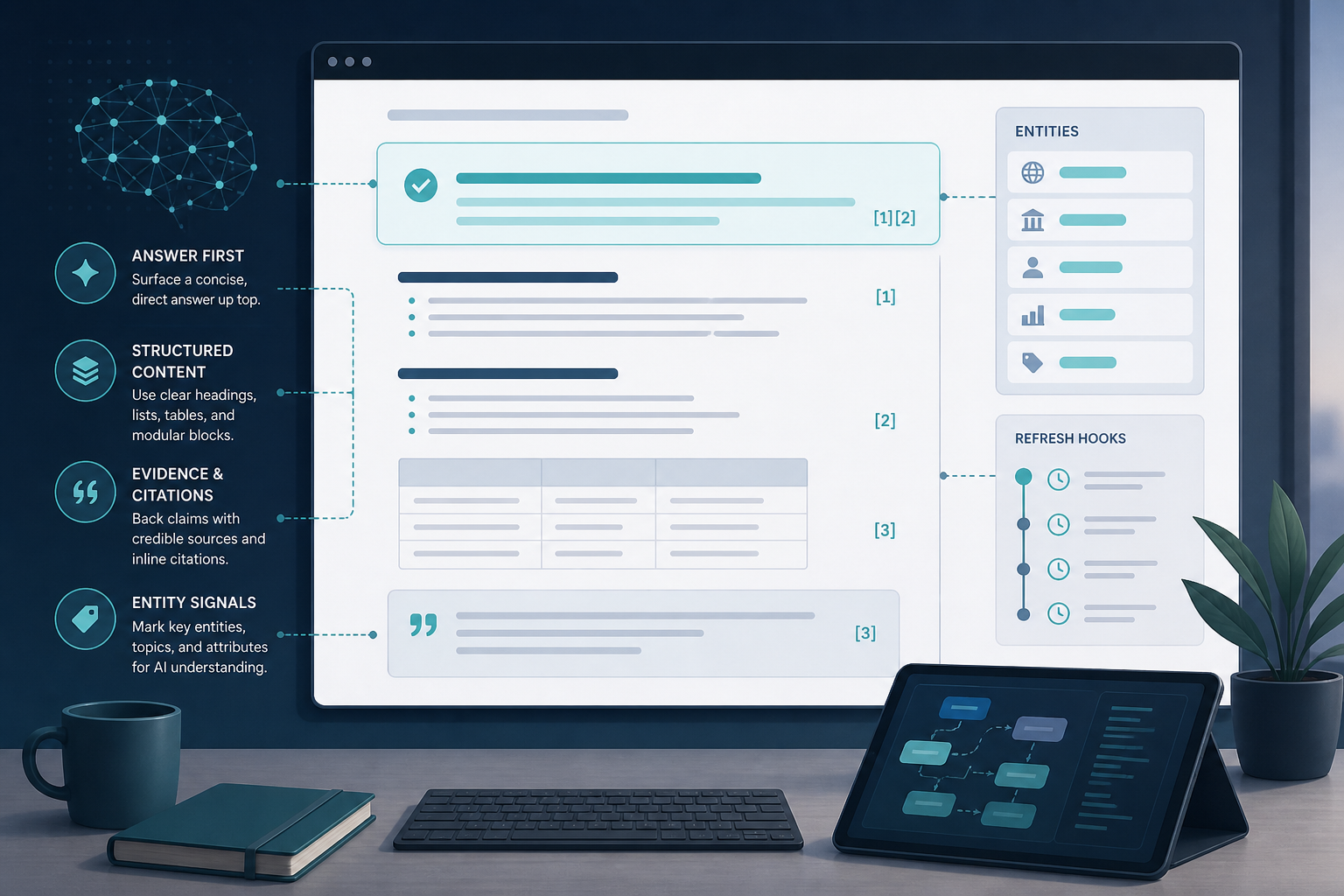
Most content still opens with a soft setup, a brand story, and a promise that the answer is coming. Answer engines do not wait. They pull the clearest, most citable block they can find, then look for evidence and named entities that make that block trustworthy. That is why answer-first content engineering for AI search visibility is becoming a production method, not a writing tip. It is how you instrument a page so machines can quote you without guessing.
This week we mapped the role side on Monday and the measurement side Tuesday through Thursday. Friday closes the loop: how engineers actually format pages for cite-ability. If you already know what a content engineer does at a growth-focused company, this is the page pattern that role ships. If you are still building the measurement stack, keep this next to your AEO checks so every refresh has a structural target, not just a copy pass.
Below you will get a practical blueprint: answer block first, evidence next, entities named cleanly, refresh hooks baked in, and a checklist you can run on any hub or spoke before you hit publish.
What answer-first content engineering actually means
Answer-first content engineering is the practice of designing a page so the primary question gets a direct, self-contained answer near the top, then supporting that answer with evidence, entity clarity, and maintenance hooks. It is engineering because the structure is intentional. Writers still craft the words. Engineers decide where the answer lives, how it is labeled, what can be extracted cleanly, and how the page stays current without a full rewrite every quarter.
It is easy to confuse this with “write shorter” or “add an FAQ.” Those are tactics. The method is broader. You treat the page like a system that has to serve three readers at once: a human skimming for clarity, a search engine scoring relevance, and an answer engine selecting passages to cite. When those three needs conflict, answer-first design resolves the conflict in favor of a quotable block that is still honest and useful for people.
In practice, that means the first screen after the title should usually contain a complete answer in two to four sentences, not a teaser. Then the rest of the article expands, proves, and operationalizes that answer. You are not dumbing the piece down. You are front-loading the extractable unit so the deeper sections do not have to do double duty as the snippet.
This sits inside the broader AI content engineer role and workflows we already documented. The role owns schemas, templates, refresh automation, and quality gates. Answer-first engineering is one of the gates: if the page cannot answer the query in a clean block, it is not ready for AI-visible distribution, even if the SEO brief looks complete.
Why traditional intros fail answer engines
Classic blog intros were built for dwell time and brand warmth. They delay the point on purpose. That worked when the page was the only destination. In AI search, the engine often decides whether you are citation-worthy before a human ever scrolls. A long throat-clearing intro becomes invisible content. The model may never reach the paragraph where you finally say the useful thing.
We see the same pattern when teams “optimize for featured snippets” by stuffing a definition halfway down the page. Engines can find mid-page answers, but they prefer consistency: question clarity in the title or H2, answer nearby, evidence attached. If your best sentence is buried under 400 words of context, you are asking the model to do editorial work you should have done yourself.
Another failure mode is the multi-intent opening. The intro tries to speak to beginners, buyers, and practitioners in one paragraph. Humans can navigate that. Passage selection systems struggle. They want a block that maps to one question. Answer-first engineering forces you to pick the primary question for the URL, answer it cleanly, then branch into secondary intents with their own headings.
If you want the selection mechanics in more depth, our breakdown of how AI answer engines select and cite sources covers retrieval, trust signals, and why some strong Google pages still get skipped. This post assumes you already accept that selection is passage-based. The job here is to build passages worth selecting.
The four building blocks of cite-able pages
Every answer-first page we ship for clients leans on four building blocks. Miss one and you can still rank. Miss two and you usually lose the citation fight even when your topical coverage is fine.
- Answer block: a direct, self-contained response to the primary query, placed early, written so it can stand alone when quoted.
- Evidence layer: proof that supports the answer: data, process steps, examples, decision criteria, or attributed claims you can stand behind.
- Entity clarity: consistent naming for products, roles, methods, and brands so models can resolve who and what you mean.
- Refresh hooks: visible dates, version notes, metrics callouts, or modular sections that make it obvious what to update and when.
These blocks map cleanly to how content engineers work with writers. The writer owns clarity and voice inside the answer. The engineer owns placement, labeling, schema, internal links, and the refresh contract. That split keeps production moving without turning every article into a committee draft.
If your team is still defining ownership, the content engineer job description is a useful RACI companion. Answer-first format is one of the deliverables that should appear on that scorecard, next to templates and automation.
Build the answer block before you write the rest
Start with the query the URL is supposed to win. Write the answer as if someone asked you in a meeting and you had forty-five seconds. No throat clearing. No “it depends” without the default path. Then expand that block into the article outline.
A strong answer block usually has three traits. First, it is complete enough that quoting only that block still helps the reader. Second, it uses the primary phrase once in a natural way without stuffing. Third, it sets a scope boundary so the model does not invent extras. For this topic, a good block might say what answer-first engineering is, who owns it, and what outcome it targets (more cite-able passages, not more word count).
Place that block immediately after a short framing paragraph, or as the first H2 body. Do not hide it behind a table of contents wall. If your CMS injects a TOC widget, keep the answer above it or make the first TOC item the answer heading itself.
Answer block patterns that extract cleanly
We use a few repeatable patterns:
- Definition plus method: one sentence definition, then two sentences on how the method works.
- Decision answer: “Do X when A, do Y when B,” with a default for edge cases.
- Checklist answer: “Answer-first pages need these four elements,” then expand each later.
- Workflow answer: numbered steps summarized in prose before the long walkthrough.
Pick one pattern per URL. Mixing patterns in the first block creates mush. Secondary patterns belong in later H2s where they answer follow-up questions.
In practice, we often write the answer block in a shared doc, run it past a subject-matter owner, then lock it before drafting the rest. That prevents the common late-draft problem where the body drifted and nobody updated the opening. The block becomes the contract for the page.
Add evidence that models can trust and humans can use
Answer engines prefer claims they can corroborate. That does not mean you need a footnote farm. It means your evidence should be specific, checkable, and attached to the claim it supports. Vague authority language (“industry leaders know”) fails both humans and machines.
Useful evidence for B2B marketing pages includes process examples, before/after measurement notes, decision tables, anonymized client patterns, and paraphrased public research with clear sourcing language. Keep the evidence close to the claim. A brilliant case study three scrolls down does not rescue a weak answer block.
We also treat internal links as evidence of topical depth when they point to real supporting articles. Linking to how to get your content cited in AI-generated answers tells both readers and crawlers that this production method connects to a citation outcome hub. Soft-linking high-impression AEO hubs helps too, as long as you are not restating their definitions. For business framing, point people who need the commercial why to what AI search visibility means for businesses, then keep this page on the how.
Evidence that belongs near the answer
Right under the answer block, add one short proof unit:
- a three-row decision table,
- a numbered mini-workflow,
- a concrete example with role ownership,
- or a metric you actually track (without inventing precision).
That unit is often what gets pulled alongside the answer. It turns “we say this works” into “here is the operating shape.”
Name entities the way your knowledge graph needs them
Models resolve meaning through entities: brands, products, roles, methods, tools, and places. If your page uses five nicknames for the same role, you make resolution harder. Answer-first engineering includes an entity pass. Pick canonical names. Use them consistently in headings, answer blocks, and schema where relevant.
For Click Laboratory content, that means being consistent about “content engineer,” “AI content engineer,” “answer engine optimization,” and product or service names. It also means not inventing parallel jargon for the same idea across posts. When a page introduces a method name, define it once in the answer block, then reuse the same label.
Entity clarity also shows up in how you talk about competitors and categories. Soft-link to category pages when you reference platforms or services, for example our guide to content engineering platforms and services, without turning this article into a vendor dump. The point is to help the model map your method to a known category, not to list tools.
Same rule for measurement entities. If you mention AEO metrics, link to the roadmap post and move on. Do not redefine the metric set here. Readers who need the 90-day measurement plan can open AEO metrics to track and a 90-day experimentation roadmap. This page stays on production format.
Instrument refresh hooks so cite-ability does not decay
A cite-able page that goes stale becomes a liability. Answer engines notice outdated stats, old product names, and processes that no longer match the live site. Content engineers should leave refresh hooks in the page itself, not only in a project tracker.
Refresh hooks can be as simple as a “Last reviewed” line near the answer, a modular stats subsection with a review date, or a checklist section labeled for quarterly updates. Better hooks are structural: separate the durable method from the volatile numbers so you can refresh evidence without rewriting the answer.
This is where Monday’s role work meets Tuesday through Thursday’s measurement week. Once you can see whether competitors are getting cited more, or how trackers score your presence, you need a production response. Automating that response is exactly what we cover in the content engineer role in automating refresh workflows. Answer-first pages make automation easier because the units to refresh are already modular.
In practice, we attach each hub to a refresh class: light (links and dates), medium (evidence and examples), heavy (answer block rewrite). Measurement signals decide the class. Format decides how expensive the class is. That is the whole point of engineering the page up front.
A production workflow content engineers can run
Here is a workflow we use when converting an existing post or shipping a new answer-first piece. It is intentionally boring. Boring is repeatable.
- Lock the primary question. One URL, one primary question. Secondary questions become H2s, not competing openers.
- Draft the answer block. Two to four sentences. Self-contained. Scope clear. Keyword used once if natural.
- Attach one evidence unit. Table, steps, or example immediately after the block.
- Map entities. Canonical names list for the page. Fix synonyms in headings.
- Outline expansion H2s. Each H2 answers a follow-up a human or model would ask next.
- Place internal links in body copy. Hub link early on the primary phrase. Spoke links where they support a claim.
- Add refresh hooks. Dates, modular evidence, ownership note for who reviews.
- QA for extractability. Read only the answer block out of context. If it fails alone, rewrite it.
- Ship, then measure. Connect to your AEO checks from this week’s measurement posts, not vanity traffic alone.
Writers and engineers can split steps 2 through 5, but someone has to own the extractability QA. That is usually the content engineer, because they see the page as a system. If you are hiring into that seat, keep the workflow next to the job description rather than treating format as “editorial preference.”
Teams without a dedicated engineer can still run this with a senior strategist owning steps 1, 8, and 9. The risk is inconsistency across dozens of URLs. Templates help. So do platforms and services when the volume justifies them, which is why some orgs evaluate content engineering platforms after they prove the method on a handful of hubs.
Page anatomy: where each piece should live
Think of the page as layers from top to bottom:
- Title: signals the primary question and outcome.
- Opening frame (optional, short): why the reader is here, one or two sentences max.
- Answer block: the extractable unit.
- Evidence unit: proof attached to the answer.
- Method sections: H2s that expand the how.
- Examples / in practice: grounded scenarios.
- Measurement bridge: how you know it worked, with links out to AEO posts.
- Closing CTA bridge: human next step, not another soft intro.
FAQ toggles sit after the CTA in our WPBakery pattern. They catch long-tail questions without cluttering the answer path. Keep FAQ answers long enough to be useful, but do not move the primary answer into the FAQ. The FAQ is secondary coverage.
This anatomy also helps with living content operations. When something changes, you usually touch one layer. Product rename? Entity pass. New metric? Evidence unit. Method still true? Leave the answer alone. That discipline is what keeps hubs authoritative without constant full rewrites.
Connecting Monday's CE role to measurement week
Monday’s growth-company content engineer post explained the seat. Tuesday through Thursday covered how to see answer-engine presence, competitor citation gaps, and how trackers work. Friday’s method is the production response those signals deserve.
Without answer-first engineering, measurement becomes a report that nobody can act on. You learn you are missing from answers, then ship another long essay with the same soft intro. With the method in place, a tracker alert can point to a specific fix: rewrite the answer block, refresh the evidence unit, clarify the entity name, or schedule a medium refresh.
That is also how you avoid duplicating definition posts. We already have strong pages on visibility concepts and metrics. New production content should teach format and workflow. Link out for definitions. Stay on instrumentation here. Readers who need the commercial frame can open the visibility hub; readers who need the scoreboard can open the metrics roadmap; readers who need the cite playbook can open the citation guide. This URL owns answer-first engineering.
Common mistakes that kill cite-ability
A few patterns show up again and again when we audit pages that “should” get cited and do not.
- Answer buried under brand story. Fix: move the block up; keep brand voice in later sections.
- Answer that is not self-contained. Fix: rewrite until quoting only that block still makes sense.
- Evidence nowhere near the claim. Fix: attach a proof unit under the answer.
- Entity soup. Fix: canonical names list and a pass on headings.
- Refresh only in Asana. Fix: put hooks on the page so the next editor sees them.
- FAQ as the real answer. Fix: promote the primary answer into the body; keep FAQ secondary.
- Tool dumps instead of method. Fix: teach the format; link out for platforms if needed.
- Duplicating a definition hub. Fix: soft-link the hub and stay on production steps.
Most of these are structural, which is good news. Structure is cheaper to fix than authority. You do not need a new domain to become more cite-able. You need cleaner passages on the URLs you already have.
In practice: converting a soft intro into an answer-first hub
Take a typical “guide to X” that opens with market context for six paragraphs. The useful definition sits under the third H2. Traffic is fine. Citations are rare. The conversion looks like this.
First, extract the definition and method into a new answer block and place it after a two-sentence frame. Second, pull the best checklist or table up under that block. Third, rename headings so each one is a question or a clear task. Fourth, run an entity pass so product and role names match the rest of the cluster. Fifth, add a last-reviewed line and mark which subsection owns volatile stats. Sixth, weave internal links to the CE hub, the citation guide, and the refresh automation post where those claims appear.
Then measure. If your AEO checks show more mentions or citations after the refresh, keep the format. If not, inspect whether the answer block is still vague, or whether competitors simply have stronger corroborating sources. Format cannot invent authority, but it can stop you from hiding the authority you already have.
We have run this conversion on analytics and AEO hubs where the topic was already strong. The lift usually shows up first as cleaner passage matches in manual answer checks, then as more stable citations over a few weeks. It is not magic. It is making the page easier to quote.
Checklist: ship-ready answer-first QA
Before you mark a page ready for AI-visible distribution, run this checklist:
- Primary question for the URL is explicit in the title or first H2.
- Answer block appears early and stands alone when quoted.
- Primary keyword appears naturally in the first paragraph and links to the best hub.
- One evidence unit sits directly under the answer.
- Entity names are consistent across title, headings, and body.
- Internal links are woven into claims, not dumped in a related-reading list.
- Refresh hooks identify what ages and who owns the review.
- FAQ covers secondary questions without stealing the primary answer.
- Page does not duplicate a live definition or tool-list intent.
- Measurement owners know which AEO check will validate the change.
Print it. Put it in the CMS checklist. Make it a required gate for hub refreshes. The goal is not perfection on every blog note. The goal is consistency on the URLs that already carry topical authority.
Turn answer-first pages into a cite-ready content system
Answer-first content engineering is how you connect the content engineer seat to the AEO measurement work you already started this week. The answer block makes you selectable. Evidence and entities make you trustworthy. Refresh hooks keep you current. Together they turn pages into assets answer engines can quote without guessing.
If you want help installing this as a production standard across your hubs, we will review a sample of your pages, mark the extractability gaps, and outline a practical refresh sequence your team can run. Book a free consultation and we will walk through the highest-leverage URLs first.
Ready when you are. Bring one hub you care about and the questions you want to win in AI answers. We will show you what an answer-first rebuild looks like on your own content.
Answer-first content engineering: questions teams ask
Practical answers on answer blocks, evidence, entities, refresh hooks, and how this method connects to AEO measurement without turning every post into another definition page.
What is answer-first content engineering?
Answer-first content engineering is a production method for building pages so the primary question gets a clear, self-contained answer near the top, then supporting that answer with evidence, consistent entity names, and refresh hooks. It is engineering because placement, structure, and maintenance are intentional, not left to late-draft luck.
Writers still own voice and clarity inside the block. Content engineers own templates, extractability QA, schema where needed, and the refresh contract. The outcome is not shorter content for its own sake. It is passages that humans can use immediately and answer engines can cite without reconstructing your point from scattered paragraphs.
If you already run content engineering workflows, treat answer-first format as a quality gate before publish. If you are new to the seat, start by converting a few high-authority hubs rather than rewriting the whole blog at once.
Where should the answer block sit on the page?
Place the answer block immediately after a short framing paragraph, or as the first major section body. The goal is early extractability. If a table of contents or hero widget pushes the answer down, adjust the template so the block still appears before deep context.
Do not hide the primary answer inside an FAQ toggle. FAQs are for secondary questions. The primary answer belongs in the main article path where both humans and passage selectors expect it. A good test is simple: copy only the answer block into a blank doc. If it still helps, placement can stay. If it depends on later paragraphs to make sense, rewrite the block before you argue about position.
On long pillars, you can restate a shortened version later, but the first instance should be the strongest and most complete.
How is this different from writing for featured snippets?
Featured snippet tactics often focus on matching a Google SERP feature with a definition or list. Answer-first content engineering is broader. It designs the whole page so answer engines can select a trustworthy passage, corroborate it with nearby evidence, resolve entities, and keep returning to a page that stays fresh.
You still benefit from clear definitions and lists. You also add production rules: entity consistency, modular evidence, refresh hooks, and explicit ownership. Snippet chasing can produce a one-off paragraph. Answer-first engineering produces a maintainable system across hubs and spokes.
Use snippet lessons where they help, then go further. The page should work when there is no blue-link snippet at all, because many AI answers never show your URL the way classic SEO reports expect.
What evidence should sit under the answer block?
Use one compact proof unit that supports the claim without forcing a scroll. Decision tables, numbered mini-workflows, concrete role-based examples, and clearly attributed paraphrases of public research all work well. Keep the unit specific and checkable. Avoid vague authority language that cannot be verified.
Internal links can reinforce topical depth when they point to real supporting articles, such as citation guides or refresh automation posts. Do not replace evidence with a tool list. Tools belong in evaluation pieces. Here, evidence should prove the method.
If your best proof lives deep in the article, promote a shortened version under the answer and keep the full case study later. Passage selection often happens near the top.
How do refresh hooks work in answer-first pages?
Refresh hooks are on-page cues that tell editors what ages and how to update it without rewriting everything. Examples include a last-reviewed line near the answer, a modular stats subsection, version notes, and labeled checklists for quarterly review. The durable method stays stable. Volatile numbers and examples stay modular.
Hooks matter because cite-ability decays when entities rename, stats age, or processes change. Measurement can tell you a page is slipping. Hooks make the fix cheap. Pair them with automation where your content engineer already owns refresh workflows, so tracker alerts map to a known refresh class: light, medium, or heavy.
Put the hooks in the CMS content, not only in a project tool. The next editor should see them without opening Asana.
Who owns answer-first QA on a marketing team?
Ideally a content engineer owns extractability QA, templates, and refresh contracts, while writers own clarity and voice inside the blocks. Strategists or AEO owners connect the page to measurement checks. That RACI keeps format from becoming everyone’s vague responsibility and nobody’s job.
Smaller teams can assign the gate to a senior strategist. The risk is inconsistency at volume. If that happens, document the checklist, require it on hubs, and revisit platforms or services only after the method works on a short list of URLs.
Do not leave QA as a polite suggestion in the style guide. Make it a publish requirement for the pages that already carry topical authority.
How does this connect to AEO measurement?
Measurement tells you whether you appear and get cited. Answer-first engineering tells you what to change when you do not. Without format, AEO reports become interesting slides. With format, a missing citation can point to a weak answer block, thin evidence, messy entities, or a stale section.
Run your presence and competitor checks, then map findings to production actions. Link out to your metrics roadmap and citation hubs for the scoreboard. Keep this page focused on the page instrument itself. That split prevents another definition post and gives operators a clear handoff.
After a refresh, re-check the same prompts. If passage quality improved but citations did not, investigate authority and corroboration next. Format first, then deeper trust work.
Can we apply answer-first engineering to old posts without a full rewrite?
Yes, and that is usually the highest ROI path. Extract the real answer from the existing draft, place it early, attach one evidence unit, clean entity names in headings, add refresh hooks, and weave a few internal links where claims need support. Leave durable sections alone when they still help.
Full rewrites are for pages where the method itself changed or the intent no longer matches the URL. Most citation gaps are structural. Fix structure first. Then use measurement to decide whether a heavier refresh is worth the calendar time.
Start with hubs that already earn impressions or topical authority. Converting weak thin posts first wastes energy. Convert the pages answer engines would consider anyway, then make them easier to quote.