
Video has been helping websites convert for years, but the conversation has changed.
Back in 2017, it was enough to say that video could make a page more engaging and help people understand a product or service faster. That is still true, but today the role of video is much bigger. Video is no longer just something you add to a homepage or landing page. It now shapes how people discover brands, evaluate trust, compare options, and decide whether to act, often across multiple platforms before they ever fill out a form or make a purchase.
That means the real question is no longer whether video can improve conversion rates. It can. The better question is how to use video in a way that supports the entire customer journey, from the first impression on social media to the final decision on your website.
Why video still matters so much
People are busy, distracted, and often skeptical. Video helps because it can communicate faster than blocks of text alone. It can show, not just tell. It can reduce uncertainty, create familiarity, and help a visitor feel like they understand what you do before they have to commit to anything.
That matters because conversions are usually held back by friction. Sometimes that friction is confusion. Sometimes it is lack of trust. Sometimes it is simply that a visitor does not have enough motivation to keep going. Video can help with all three when it is used well.
But using it well is the key. A heavy, slow-loading video that delays the page experience can hurt performance. A vague brand video that looks polished but says very little can waste attention. A short clip that gets views on social media but does not connect to a next step may generate awareness without producing results. Video is powerful, but only when it is connected to intent, platform, and conversion goals.
The basic idea still holds
The graphic below still supports an important truth: different kinds of video can influence different parts of the conversion process.
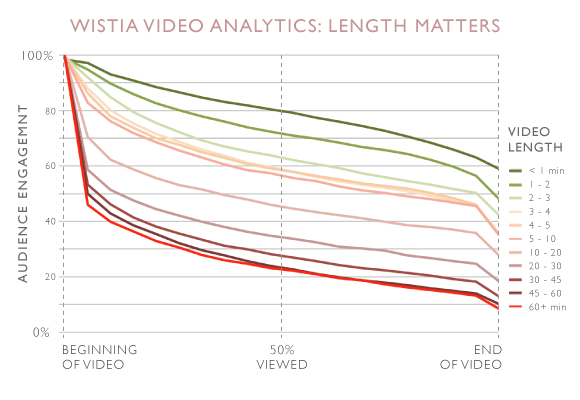
That idea is still useful today because conversion is rarely a single moment. People move from awareness to interest, from interest to consideration, and from consideration to action. Video can support each of those stages, but not usually with the same asset in the same place.
A person who sees a short clip on Instagram may only be ready for curiosity. A person watching a YouTube video may be looking for more context. A visitor on your website may be much closer to making a decision and need reassurance, clarity, or proof. The job of video changes depending on where the person is in that process.
So rather than thinking about video as one tactic, it is better to think of it as a set of communication tools that work together.
Video and conversion are now part of a larger ecosystem
In 2017, a lot of video strategy focused on the website itself. That is still important, but today your website is only one part of the journey.
Many people first encounter video on social platforms. Short-form content has become one of the most-used and best-performing formats for marketers, especially on TikTok, Instagram Reels, and YouTube Shorts. HubSpot’s recent reporting highlights short-form video as a leading content format for marketers, which means businesses now need to think about video not just as an on-page asset, but as a cross-channel conversion driver.
That changes how businesses should think about conversion.
A conversion may start with a short-form video on TikTok that introduces a problem. It may deepen through a YouTube video that explains a solution. It may finish on a landing page where a testimonial video removes the last bit of hesitation. In that sense, video often works as a sequence rather than a single event.
The smartest use of video today is not just asking, “Should we put a video on this page?” It is asking, “What kind of video helps this audience take the next step from where they are now?”
Short-form video now belongs in the conversion conversation
Short-form video has changed expectations. People are used to content that gets to the point quickly. They expect a strong opening, visual clarity, and relevance almost immediately. That is why short-form video needs to be part of any modern conversation about increasing conversion rate.
This does not mean every brand should turn everything into a trend-driven clip. It means businesses need to understand that short-form video now plays an important role in moving people toward action.
On Instagram, short-form video can build familiarity and keep a brand visible. On TikTok, it can create discovery and reach new audiences quickly. On YouTube Shorts, it can introduce topics that lead viewers toward longer content or directly to a website. These are not just awareness channels anymore. They are often the top of the conversion path.
The important thing is alignment. A short-form video should not exist in isolation. It should connect to a broader message, a stronger landing experience, and a next step that makes sense. A clip can grab attention, but it still needs somewhere meaningful to send that attention.
Website video still plays a different role
If short-form video helps create momentum, website video often helps convert that momentum.
When someone lands on your site, the job of video becomes more specific. Now it has to answer questions, clarify value, build trust, and reduce the anxiety that keeps people from taking action. This is where longer explainers, testimonial videos, service walkthroughs, process videos, and FAQ videos become especially useful.
A homepage video may help explain what you do. A landing page video may help reinforce an offer. A product page video may help show how something works. A testimonial video may help a visitor believe your promises are credible. A founder or team video may help make the business feel more human.
These uses of video are not primarily about entertainment. They are about reducing friction.
That is why businesses should avoid vague “brand videos” that look attractive but do not help a visitor make progress. Good conversion-focused video is clear about its purpose. It does not just express personality. It helps someone move forward.
Mobile makes all of this more important
Any modern article about video and conversion has to address mobile first.
Most web traffic now comes from mobile devices worldwide, which means the first real experience many people have with your content is happening on a phone, not a desktop computer.
That matters because mobile changes the way video is consumed. Smaller screens make clarity more important. Slower connections make performance more important. Muted playback makes captions more important. Shorter attention windows make the first few seconds more important.
A video that works well on desktop can fail badly on mobile if it is too slow to load, too visually cluttered, too long to earn attention, or too dependent on sound. Businesses should assume that mobile readability, mobile pacing, and mobile usability are essential to conversion performance.
This applies both on-site and on social platforms. On Instagram, YouTube, and TikTok, mobile is the primary viewing environment. On your website, it is often the primary browsing environment. That makes mobile-first video design a conversion issue, not just a production choice.
Accessibility is part of conversion too
One of the biggest changes from older video advice is the importance of accessibility.
Captions, transcripts, and clear visual communication are not optional extras anymore. They improve usability for everyone, especially in environments where sound is off, attention is divided, or comprehension needs to happen quickly. WCAG guidance requires captions for prerecorded synchronized video content, and beyond compliance, captions simply make video easier to consume.
This matters on social platforms where many people watch without audio. It also matters on websites, where users may skim before deciding whether to commit their time. A captioned video respects the viewer’s context and helps the message land faster.
Accessibility also overlaps with SEO and content reuse. Transcripts can support search visibility, content repurposing, and better user experience. A business that produces one video well should be able to turn it into multiple forms of usable content.
Video SEO now matters much more
Another major change since 2017 is that video should not only be viewed as persuasive content, but also as searchable content.
Google’s current documentation makes clear that video structured data and well-built watch pages help Google better understand video content and can influence how videos appear across Search, Video mode, Images, and Discover.
That means businesses should think beyond simply embedding a video on a page. They should also consider whether the video has the right metadata, whether it lives on a useful page, whether it supports a broader search strategy, and whether it can attract visitors as well as persuade them.
In practical terms, the best video strategy now serves both discovery and conversion. A YouTube video may help someone find your brand. A structured watch page may help a video show up in search. A landing page video may help that visitor finally act. These are not separate conversations anymore.
Page speed still has the final vote
Video can help conversions, but only if it does not get in the way of the page experience.
This is one of the most important cautions to keep in mind. A large autoplay background video that slows loading or shifts the page can make a site feel less usable, especially on mobile. A strong conversion strategy is not about adding video at all costs. It is about using video in a way that supports speed, usability, and clarity.
Sometimes that means embedding the video directly. Sometimes it means using a thumbnail with click-to-play behavior. Sometimes it means keeping the most important message in text and using the video as reinforcement rather than as the only way to understand the offer.
The goal is not to make the page feel more cinematic. The goal is to make it easier to say yes.
What kinds of video help conversion most
The answer depends on the stage of the journey, but certain formats tend to be especially useful.
A short-form clip on TikTok, Instagram Reels, or YouTube Shorts can introduce a problem, surface a pain point, or create interest in a solution. A longer YouTube video can educate, compare options, or explain a process in more depth. A website explainer can help a new visitor understand what the company actually does. A testimonial can build trust. A demo can reduce uncertainty. A FAQ video can remove objections that keep someone from filling out a form or making a purchase.
The key is not to create video for the sake of variety. It is to create the kind of video that helps a specific visitor move from their current question to their next decision.
That is what makes video conversion-focused instead of just content-heavy.
Measurement has to go beyond views
One of the easiest mistakes in video marketing is confusing attention with results.
Views, impressions, and play rates can be useful signals, but they are not the same as conversion impact. A video strategy should be measured by whether it helps people move deeper into the journey and ultimately take action.
That means asking better questions. Do people who watch the video click through more often? Do they stay on the page longer in a useful way? Do they convert at a higher rate? Do they request a demo, book a call, or purchase more often? Does one type of video outperform another for certain traffic sources or audience segments?
The purpose of measurement is not just to prove that people watched. It is to learn which kind of video actually changes behavior.
AI changes production, but not the fundamentals
AI has made video creation faster and more accessible. Teams can now use AI to assist with scripting, transcription, captioning, editing, repurposing, and ideation. That can be helpful, especially for businesses that want to produce more content across channels without dramatically increasing costs.
But AI does not change the core principles.
A weak message is still weak, even if it is produced faster. A confusing offer is still confusing, even if it is turned into ten clips. A disconnected content strategy is still disconnected, even if AI helps you publish more often.
What AI does best is reduce production friction. What it does not do is replace clarity, trust, empathy, or strategic thinking. Those are still the ingredients that make video improve conversion.
The real opportunity
The opportunity today is bigger than it was in 2017 because video has more places to influence the buyer journey.
It can attract attention on TikTok. It can build familiarity on Instagram. It can teach on YouTube. It can persuade on your website. It can support email, retargeting, sales conversations, and post-click trust building. It can function as both top-of-funnel content and bottom-of-funnel reassurance.
That is why a modern video strategy should not ask only where to place a video on a page. It should ask how video helps guide a person from first exposure to final action.
The businesses that do this well tend to see video as part of a connected system. They use short-form video to create interest, longer-form video to deepen understanding, and website video to remove friction at the point of decision. Each piece plays a role. Each platform has a purpose. Each video helps the next step happen more naturally.
Why Video Matters More Than Ever
Video still increases conversion rate, but not simply because video is engaging.
It works because the right video can make a message clearer, make a brand feel more trustworthy, make a decision feel easier, and make the next step feel more obvious.
That was true years ago, and it is even more true now.
The difference today is that conversion no longer happens in one place. It happens across platforms, across devices, and across multiple moments of attention. That is why a smart video strategy now includes website video, search visibility, mobile usability, captions, short-form content, and platform-specific thinking for Instagram, YouTube, and TikTok.
When video is treated as part of the customer journey instead of just an add-on to a webpage, it becomes much more powerful.
And that is where the biggest conversion gains are now.