Numara Software already had a sophisticated digital marketing operation.
The opportunity wasn’t simply to attract more visitors. It was to turn more of the traffic Numara already had into qualified sales opportunities.
Its website supported 12 global sites, attracted roughly 40,000 visitors per month, and served as a major lead-generation engine for a 100-person global sales organization. SEO, paid search, email, webinars, events, and other campaigns were already driving substantial traffic.
Click Laboratory used behavioral data, A/B testing, landing-page optimization, and conversion analysis to identify where relatively small changes could create significant business impact.
After six months:
Numara’s website was already well optimized.
The company had implemented strong web design and SEO practices across its global digital presence and had built monthly traffic to approximately 40,000 visitors.
But Numara’s website had an important job to do.
Marketing needed to generate enough qualified opportunities to help maintain a sales pipeline roughly three to four times the company’s sales target.
For a 100-person global sales team, incremental improvements in website conversion could translate into substantial additional pipeline.
So rather than immediately pursuing more traffic or replacing a website that was already performing well, we asked a different question:

Click Laboratory took a testing-first approach.
Instead of making a large number of changes at once, we used visitor behavior and controlled experiments to identify specific opportunities, make targeted improvements, and measure the impact.
That allowed Numara to improve the site while protecting what was already working.
One of the first tests involved something remarkably basic:
The size and spacing of the website’s body copy.
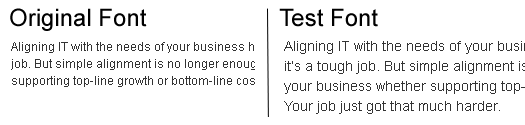
Numara’s existing design used relatively small text. We tested a larger font with additional line spacing to make longer pages easier to read.
Visually, it was a small change.
Visitor behavior changed significantly.
Behavioral analysis also showed an opportunity to give Numara’s most important conversion actions greater prominence.
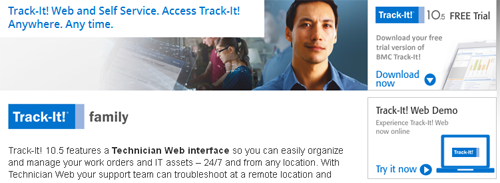
On the Numara Track-It! homepage, we redesigned the header experience to focus more attention on two valuable next steps:
Again, the objective wasn’t a complete redesign.
It was to make the actions visitors were most likely to need easier to notice and understand.
Numara’s website contained more than 400 pages and PDFs, making internal search an important part of the customer experience.
Analysis showed that site search was already one of the most commonly used navigation tools.
Instead of introducing an entirely new search platform, we tested something simpler:
Make the existing search box larger and more visible.
That change increased visitor engagement with search by 20%.
The biggest opportunity involved Numara’s paid search program.
At the time, the company was investing approximately $150,000 per month in Google AdWords campaigns that sent visitors to landing pages offering resources such as:
Rather than focusing only on generating more clicks, Click Laboratory focused on what happened after those visitors arrived.
We continuously tested elements including:
Over time, those experiments increased conversion rates from paid traffic by approximately 60%.
That improvement changed the economics of the entire program. Numara was ultimately able to reduce paid search spend by 50% while maintaining the same lead volume.
After six months of testing and optimization, Numara’s paid campaigns were generating an additional $330,000 in Sales Opportunity Pipeline Per Month.
And those results came from improving the performance of an already sophisticated website and marketing program.
The business didn’t need to double its traffic to create meaningful growth.
The results also changed how Numara thought about website optimization.
Rather than waiting years between major redesigns, the website could become something the company continuously measured, tested, and improved.
Numara already had many of the things companies usually ask marketing agencies to provide:
The larger opportunity was getting those pieces to perform better together.
Click Laboratory looked across:
We studied how visitors behaved.
We identified areas of friction and missed opportunity.
We tested improvements.
And we measured those changes against business outcomes rather than design preferences.
The latest version of the website had been in place for about a year, but the font used for all of the content had remained the same since the website had first launched. The font was Arial 10pt.
Following a common strategy used by bloggers to increase engagement, we tested increasing the font size to 13pt and added a little extra spacing between each line. Even though the previous smaller font looked better and content flowed better, the results with the larger font showed a different story. That simple change improved the bounce rate by 10%, the site exit rate by 19%, pages per visit by 24%, and an impressive 133% improvement in form conversion rate.
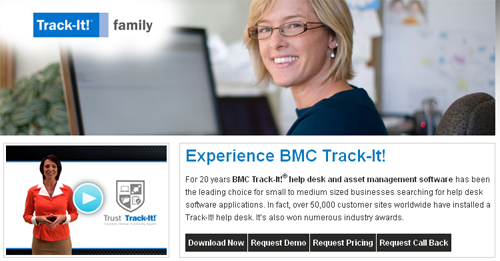
The homepage for Numara Track-It! had very little difference from the rest of the pages on the website, and it was one of the most active pages as an entry page as well as a landing page for campaigns. We felt there was a great opportunity to explore a new design to better present the call to action (CTAs) items on the page.
Studying the heatmaps for the page, we already knew that the main conversion actions on the page were being ignored by most visitors. So the heading of the page was redesigned to bring focus on the product download and pricing requests.
The result was extremely exciting. The click-through to the download CTA increased by 334% over the original design. Additionally, click-through to the pricing CTA request improved by 54%.
The Numara website had over 400 web pages and PDFs available to be searched. The search box was one of those standard things that remained the same over the various renditions of the website. The search box itself was an out of the box form field size and visible on the top of every page. When we added up all the times the search function was being used, it was the third most common form of site navigation and within the top 5 pages on the site, but its usage numbers were still quite distant from the main menu and top three pages.
So we tested changes to the size of the search box to make it taller and wider as well as the font size of the text. This change led to a very positive impact on its use. The visitor engagement of the new design was increased by 20%. So simply improving the visibility of the search box had a great impact on improving the user experience for an unmet need of site visitors.
The landing pages used by Numara Software were heavily targeted by their Google Adwords (PPC) campaigns. Numara had about a $150K/month spend. The landing pages offered different assets such as whitepapers, new and archived webinars and product downloads. A/B testing of the landing pages was a critical component to driving up conversion rates for the paid campaigns and driving down cost per acquisition. Many iterative changes were made to the landing pages, including:
The number of changes made using A/B testing over the months improved the overall conversion rates by 60% for the paid spend. Over time, this testing enabled Numara to decrease the monthly budget by 50% and still maintain the number of leads generated. This had a big impact on the acquisition cost per lead and it helped identify areas of improvement that could be made on other areas of the site and forms.
Combining A/B testing with PPC was a critical strategy for success and driving growth. Without the testing, the campaigns were generating typical conversion rates that most companies are used to seeing. When you combine the two, it will have a big impact on lead generation.
More traffic can help grow a business.
But before spending more to acquire additional visitors, it is worth asking what is happening to the people already reaching your website.
Click Laboratory helps companies identify those gaps across the customer journey and prioritize the changes most likely to improve business performance.
How to Evaluate Answer Engine Visibility Tracking Solutions
How to Refresh Stale Content for AI Visibility
Stop Choosing Ad Winners by Cost Per Lead Alone
Why Ad and Landing Page Message Match Matters