Case study · VOLT Lighting

41x ROAS From an Audience Their Other Agencies Never Thought to Target

VOLT Lighting already had agencies managing its paid media.

Rather than simply adjust bids, test new creative, or move budget between campaigns, Click Laboratory looked for a growth opportunity that wasn’t obvious inside the ad account.

We found one by connecting customer purchase data, location, timing, regional buying behavior, and Meta advertising.

Return on ad spend
Attributed revenue per $1
Ad spend
$1
Attributed revenue
$41
41x
ROAS: approximately $41 in attributed revenue for every $1 spent on advertising.
VOLT Lighting
Volt Lighting
The challenge

The Challenge: Paid Media Was Already Being Managed

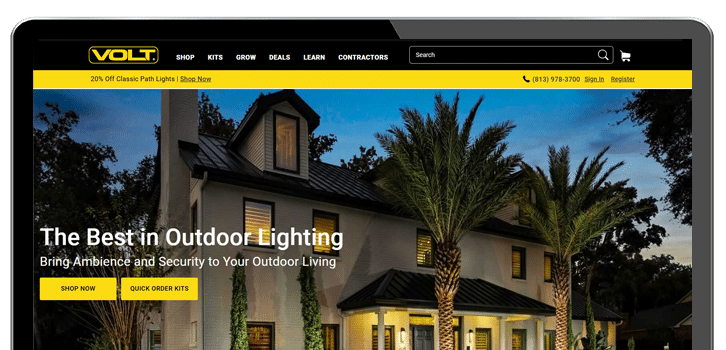
VOLT Lighting sells professional-grade outdoor landscape lighting to homeowners and professionals.

They weren’t starting from scratch.

Paid advertising was already running, and other agencies had been managing the campaigns.

That meant the opportunity couldn’t simply be:

Launch more ads
Increase the budget
Change bidding
Create another audience
Test a new headline

Those tactics can improve performance, but we wanted to understand something bigger:

What does VOLT already know about its customers that could help create the next customer?

That question took us outside the advertising platform and into VOLT’s customer and purchase data.

That’s where we found the opportunity.

The opportunity

The Opportunity Wasn't Inside the Ad Account

Outdoor lighting is different from many products.

When someone purchases and installs landscape lighting, it changes the appearance of their home.

And their neighbors can see it.

That led to a simple idea:

What if we advertised to the people living near recent VOLT customers?

Instead of treating a purchase as the end of the funnel, we treated it as a new marketing signal.

A VOLT customer purchased lighting.

The product was delivered and installed.

Their home became visible proof of what outdoor lighting could do.

Then nearby homeowners began seeing VOLT ads.

From one customer to the next
Customer Purchases
Lighting Gets Installed
Neighbors See the Result
Nearby Homeowners See VOLT Ads
Now the advertising had something working alongside it. The product itself.
Timing

Timing Was Part of the Strategy

We didn’t start targeting nearby households immediately after a purchase.

We waited approximately 20 days.

That delay gave the original customer time to receive and install the lighting before nearby prospects began seeing the ads.

The timing mattered.

Instead of reaching a neighbor before there was anything to see, we wanted the advertising to arrive when the real-world installation could help reinforce the message.

Campaign timing
~20 days
between a purchase and nearby households seeing VOLT ads
Day 0
Purchase, delivery, and installation
About day 20
Neighbor ads begin
This wasn't simply audience targeting. It was audience targeting built around customer behavior and timing.
Real customer data

We Built the Audience From Real Customer Data

Once a customer purchased from VOLT, Click Laboratory used location and audience data to identify nearby households and obtain the information needed to build targeted Meta audiences.

That meant the campaign wasn’t targeting broad groups of homeowners based only on general interests.

It was reaching people who lived near actual VOLT customers.

That created an entirely different type of prospecting audience.

Who the campaign reached
Not this
Broad groups of homeowners based only on general interests
This
People who lived near actual VOLT customers
And it came from a source the existing campaigns weren't using: VOLT's own customer activity.
Regional buying behavior

The Second Insight: People Don't Buy the Same Way Everywhere

The neighborhood strategy was only part of the opportunity.

We also analyzed VOLT’s historical purchase data to understand how buying behavior differed across the country.

The data showed that product preferences and purchasing patterns changed based on:

Location
Season
Previous buying behavior
Regional product preferences

So we didn’t treat the entire United States as one audience.

We built different advertising approaches for different states based on what customers in those markets had historically purchased.

A homeowner in one part of the country could see different products or messaging than someone in another region.

The campaigns followed what customers were actually buying instead of assuming the same offer would perform everywhere.
The system

The System Behind the Campaign

The strength of the campaign came from connecting information that is often managed separately.

Customer Data

We analyzed actual purchase history and customer locations.

Audience Strategy

We identified households near recent VOLT customers and created highly targeted audiences.

Timing

Campaigns were delayed so the customer’s lighting had time to be installed.

Geographic Segmentation

Advertising changed based on regional and seasonal purchasing behavior.

Paid Media

We built and managed the Meta campaigns needed to reach those audiences.

Measurement

We analyzed campaign performance and revenue to determine what was working and where the strategy could be improved.

Instead of optimizing one marketing channel in isolation, we connected the pieces into one customer acquisition system.
The result

The Result: 41x Return on Ad Spend

Return on ad spend
41x ROAS
Spent on advertising
$1
Attributed revenue
$41
Ad spend
Attributed revenue
The campaign generated approximately:

$41 in attributed revenue for every $1 spent on advertising.

That was an exceptional return.

But the number isn’t the most important part of the case study.

The most important part is where the result came from.

It didn't come from a new advertising platform.
It didn't come from dramatically increasing the media budget.
And it didn't come from making small adjustments to an existing campaign.
It came from finding an opportunity others had missed.
What it demonstrates

What This Case Study Really Demonstrates

It’s easy to look at an underperforming marketing program and assume the solution is:

More traffic.
More ads.
More content.
More budget.

Sometimes that’s true.

But sometimes the biggest growth opportunity is already sitting inside the business.

It may be hiding in:

Customer data
Lead history
Geographic patterns
Sales follow-up
Email engagement
Landing page behavior
Repeat purchases
Lost opportunities
Conversion data
Timing

The VOLT campaign worked because we didn’t start by asking:

The usual question
How can we improve the Facebook campaign?
We asked
How can we use what the business already knows to create more customers?
That is a very different question. And it produced a very different result.
Your opportunity

Your Opportunity Probably Won't Look Like VOLT's

Your customers may not install a product that their neighbors can see.

But your business is almost certainly producing signals that can help you improve marketing performance.

You may have customers who should be buying additional services.
You may have leads that aren't being followed up effectively.
Your landing pages may be losing people after you paid to get them there.
Different audiences may respond to different offers.
Your email list may contain opportunities that aren't being nurtured.
Your advertising may be generating leads, but the sales process may be losing them afterward.

That’s why Click Laboratory doesn’t look at advertising, landing pages, conversion, email, customer data, and follow-up as separate marketing projects.

We look at the entire path from traffic to customer.
How we work

We Find the Growth Opportunities Others Miss

Click Laboratory helps companies understand where their marketing system is working, where it is leaking revenue, and where the highest-value opportunities are hiding.

We look across:

Traffic
Advertising
Landing Pages
Leads
Follow-Up
Customers
Revenue

Then we prioritize the improvements most likely to make a difference.

Sometimes that means improving the ads.

Sometimes it’s the landing page.

Sometimes it’s email or SMS follow-up.

And sometimes, as with VOLT Lighting, the biggest opportunity is something no one has tried yet.
Services used

Services Used

Meta Advertising
Marketing Analytics & Attribution
Revenue Leak Analysis
Next step

What Is Your Marketing Missing?

You may not need more marketing.

You may need the marketing you already have to work better together.

Click Laboratory can evaluate your traffic, advertising, customer data, landing pages, lead follow-up, and conversion process to identify where the biggest growth opportunities may be.

Find Out Where Your Marketing Is Losing Revenue