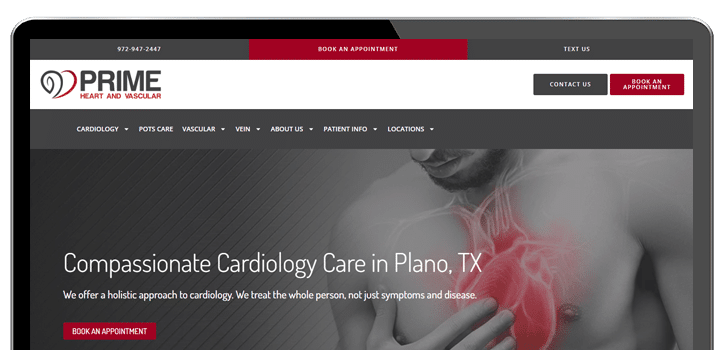
Case study · Prime Heart and Vascular

What Happened When Prime Heart and Vascular Began Publishing Highly Focused Educational Content Every Day?

Prime Heart and Vascular had been investing in SEO and educational content for years.

Click Laboratory had also been using AI to help identify topics and search opportunities that could expand the practice’s organic visibility.

But we believed there was a bigger opportunity.

Organic traffic
First three months
Before
1x
After
3.5x
3.5x
organic traffic in three months
+86%
user engagement, year over year
Prime Heart and Vascular
Prime Heart
The new model

Instead of simply using AI to create more content, we redesigned the process around a combination of:

Search behavior
AI-assisted research
Human content strategy
Editorial review
Much higher publishing frequency

Prime Heart and Vascular began publishing approximately one new, highly focused educational article every day.

Over the following three months:

Organic Traffic Increased 3.5x

And compared with the previous year:

User Engagement Improved 86%

The important part is not simply that more content was published.

It is that traffic and engagement increased together.
At a glance

Results From the First Three Months

Metric
Result
Organic traffic
3.5x increase
User engagement
+86% YoY
Publishing frequency
Approximately 1 new article per day
Content model
AI-assisted + human-directed

These results came after changing both the volume and the way content was created.

The goal was not to see how much content AI could produce.

The goal was to answer far more of the questions potential patients were already asking.
The hypothesis

The Hypothesis

Our working hypothesis was straightforward:

Prime Heart and Vascular could dramatically expand its organic visibility by publishing more narrowly focused patient education content, as long as increased production did not come at the expense of usefulness.

AI could make research and content development faster.

But humans still needed to decide:

Which topics were worth pursuing
What search intent each article should address
How narrow or broad the topic should be
How the article should be structured
Whether the finished content actually helped the reader
That distinction shaped the entire strategy.
The opportunity

The Opportunity Was in Specific Patient Questions

Broad service pages

Traditional medical websites often focus heavily on broad service pages such as:

Cardiologist
Heart testing
Vascular specialist
Vein treatment
Heart disease

Those pages are important.

But they represent only a small portion of the questions people ask about their health.

Specific patient questions

Patients also search for highly specific questions:

Why are my legs swelling?
What causes chest pressure?
Can high blood pressure damage my heart?
What does a particular heart test show?
What are the signs of vascular disease?
When should an irregular heartbeat be concerning?
When should I see a cardiologist?

Each question creates a potential entry point into the website.

Our strategy was to create useful educational content around far more of those highly specific searches.
The process

What We Changed

The biggest shift was not simply publishing more often.

We changed the content production model.

01

Use Search Behavior to Find Specific Opportunities

Instead of starting with broad editorial ideas, we focused on the questions, symptoms, conditions, tests, and concerns people were actively researching.

That allowed us to identify topics with a much clearer search intent.

02

Use AI to Increase Research and Production Capacity

AI helped accelerate several parts of the process.

It could assist with topic exploration, uncover related questions, organize research, and help create a starting point for content development.

That made it possible to address significantly more topics than a traditional content process would have allowed.

03

Keep Humans Responsible for the Strategy

AI did not decide what should be published.

Human strategy determined which opportunities made sense, how topics should be approached, and whether the finished article delivered enough value to justify its existence.

04

Narrow the Focus of Each Article

Instead of trying to answer many unrelated questions on one broad page, articles increasingly focused on a single topic or patient concern.

That created clearer content for both the reader and search engines.

05

Increase Publishing to Approximately One Article Per Day

With the new workflow in place, Prime Heart and Vascular was able to dramatically increase publishing frequency while keeping the content focused on useful educational topics.

Why it matters

Why Highly Focused Content Matters

Someone searching for a cardiologist already knows the type of doctor they need.

But many people begin their search much earlier.

They may be researching
a symptom.
A test.
A diagnosis.
A medication.
A risk factor.
Or simply trying to understand whether something happening to their body is normal.

Educational content gives a medical practice the opportunity to be helpful at that stage of the journey.

It also dramatically expands the number of ways someone can discover the practice through search.

Instead of relying on a relatively small number of service pages, the website begins to build hundreds of highly relevant entry points around real patient questions.
Result: organic traffic

Organic Traffic Increased 3.5x in Three Months

After moving to the new content model and increasing publishing frequency:

Previous level
1x
After three months
3.5x

Organic Traffic Grew to 3.5x Its Previous Level Over a Three-Month Period

That is the clearest indication that the expanded content footprint was allowing Prime Heart and Vascular to appear for a much larger range of searches.

But traffic alone would not have been enough to validate the strategy.

If visitors arrived and immediately found the content unhelpful, increased traffic would have had limited value.

That is why the engagement data matters.
Result: engagement

User Engagement Improved 86% Year Over Year

During the same period:

Previous year
Baseline
Same period this year
+86%

User Engagement Increased 86% Compared With the Previous Year

That result is important because it helps separate useful growth from simple content volume.

Prime Heart and Vascular was not just attracting more visitors.

Those visitors were also engaging more with what they found.

The combination of:

3.5x organic traffic
and
86% stronger engagement

suggests that the strategy was expanding reach while still attracting people who found the content relevant enough to interact with it.

What the data suggests

What Our First-Party Data Suggests

This case study does not show that publishing AI-generated content every day will automatically improve SEO.

That would be the wrong conclusion.

What the Prime Heart and Vascular results suggest is that increased content velocity can work when several conditions are present:

Topics are based on real search behavior
Articles answer specific audience questions
Content is narrowly focused
AI is used to increase research and production capacity
Humans remain responsible for strategy and quality
Publishing is consistent enough to build a much larger organic footprint
AI made the process faster.
It did not replace the strategy.
Search entry points

Why This Approach Produced More Search Entry Points

Every useful article created another opportunity for someone to discover Prime Heart and Vascular.

One article might attract traffic from a small number of searches.

Another might address a completely different patient concern.

Individually, many of these pages may represent relatively narrow opportunities.

Collectively, they can create a very large organic footprint.

The new model allowed Prime Heart and Vascular to cover significantly more of the questions surrounding cardiovascular and vascular health.

That expanded the website beyond a collection of service pages into a much broader educational resource.

What this demonstrates

What This Case Study Demonstrates

The debate around AI content often focuses on the wrong question:

Should companies use AI to create content?

Our experience with Prime Heart and Vascular suggests a better question:

Can AI help a company create more useful content without sacrificing strategy and quality?

For this engagement, the answer was yes.

Click Laboratory combined:

Search Data
AI-Assisted Research
Human Strategy
Focused Educational Content
Organic Visibility
Engagement

That process resulted in:

3.5x organic traffic growth in three months
and
86% year-over-year improvement in user engagement

The technology mattered.

But the process around the technology mattered more.
Services used

Services Used

Content Engine
Get Better Traffic
Customer Journey Analysis
Next step

AI Should Improve Your Content Strategy, Not Just Increase Your Output

The easiest thing to do with AI is publish more.

That does not automatically mean the content will rank.

And it does not mean people will find it useful.

Click Laboratory helps companies use AI as part of a larger content system built around real customer questions, search behavior, human strategy, and measurable performance.

Don't use AI just to create more content.

Use it to answer more of the questions your customers are already asking.