A Practical Guide to Fixing Your Lead Generation System
When leads slow down, the first reaction is usually pretty predictable.
We need more traffic.
Sometimes that is exactly right.
But spending more money on Google Ads, Meta, SEO, content, or another marketing campaign before you know what is broken can get expensive quickly.
Because traffic is only one part of lead generation.
You can have plenty of visitors and a weak offer.
You can have a great offer and a landing page nobody responds to.
You can generate leads all day and have terrible follow up.
You can even have all of those things working and discover that your advertising is attracting people who were never likely to become customers in the first place.
So before you turn up the marketing budget, figure out where people are getting lost.
A basic lead generation system looks something like this:
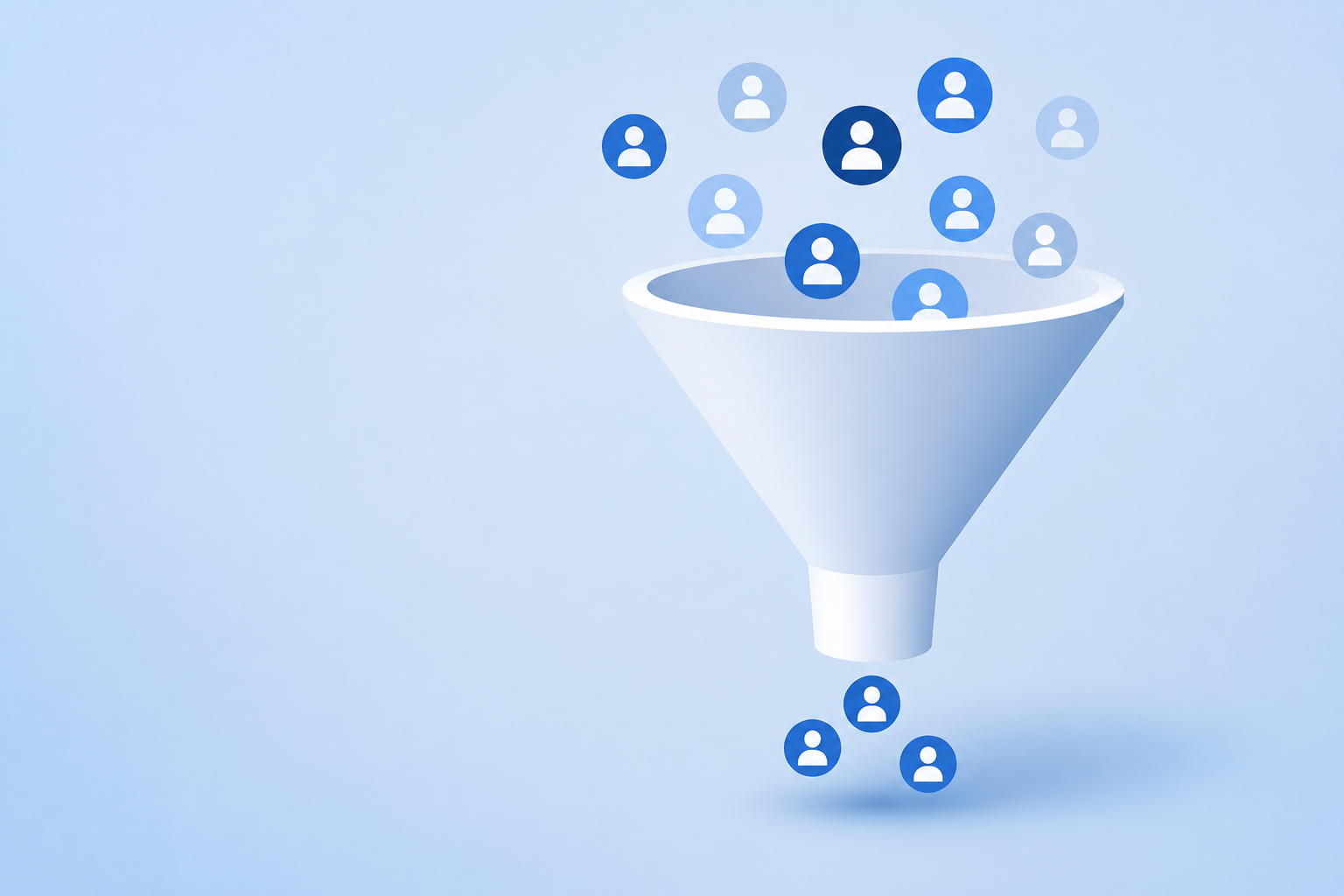
Audience → Ad or Traffic Source → Offer → Landing Page → Lead → Follow Up → Customer
 Every arrow matters.
Here is how to start fixing each part.
1. Start With the People You Actually Want as Customers
This sounds obvious, but it is where I would start.
Do not begin by opening Meta Ads Manager and scrolling through targeting options.
Start with your customers.
Pull your customer list for the last six to twelve months and look for patterns.
- Who are your best customers?
- What did they buy?
- What was the original problem they were trying to solve?
- How much were they worth?
- How quickly did they make a decision?
- Where did they come from?
Then look at the opposite group.
- Which leads wasted the most time?
- Which inquiries almost never closed?
- What characteristics show up again and again among poor prospects?
You are trying to get to a simple statement that sounds something like this:
We want more owners of established medical practices who are already spending money on marketing but are frustrated by inconsistent patient lead generation.
That is much more useful than:
We target doctors.
The better you understand the problem, the customer, and the moment that causes them to start looking for help, the easier everything else becomes.
Your advertising gets better.
Your offer gets better.
Your landing page gets easier to write.
Your sales conversations get better.
Feed the advertising platforms better information
This has become increasingly important.
Advertising platforms are getting better at making targeting decisions themselves. That means your job is less about finding some magical combination of interests and more about giving the system good information about the people who actually matter.
Meta, for example, recommends using existing customer data when creating audiences designed to find people similar to your best customers. Meta also recommends connecting lead campaigns to a CRM so that lead quality and downstream results can be used to improve campaign optimization.
Google is moving in the same general direction with enhanced conversions for leads, which allows advertisers to send offline lead outcomes back to Google so the system has better information about what happens after the original form submission.
That matters because a lead is not necessarily a success.
A qualified lead is better.
A sales opportunity is better still.
A customer is what you actually wanted.
Whenever possible, your marketing systems should know the difference.
2. Give People a Better Reason to Respond
Once you know who you want, ask a tougher question:
Why should that person contact you right now?
“Contact us” is not much of an offer.
Neither is:
Learn more.
Schedule a consultation.
Request information.
Those are actions. They do not explain why taking the action is worthwhile.
A strong offer answers:
What am I going to get?
How will it help me?
How difficult is this going to be?
What happens after I respond?
Imagine a company that helps businesses improve their websites.
Compare these two calls to action:
Contact us for website services.
Versus:
Get a website lead generation review. We will show you three places your current site may be losing potential customers.
The second one gives me a reason to respond.
That does not mean every business needs a free audit. Your offer has to make financial and operational sense.
But spend some time developing it.
Try creating three different types of offers
Instead of falling in love with the first idea, develop several.
Offer 1: Diagnose the problem
Assessment, evaluation, audit, review, estimate, analysis.
Offer 2: Help achieve an outcome
Consultation, plan, strategy session, demonstration, trial.
Offer 3: Teach something valuable
Guide, webinar, calculator, research report, checklist, email course.
Then test them.
You may discover that your audience does not want another ebook.
They want somebody to tell them what is wrong.
Or the opposite may be true. They may be too early in the buying process to schedule a consultation, but they are perfectly willing to give you their email address for something genuinely useful.
Do not guess forever.
Put the offers in front of real prospects and see what happens.
3. Make Sure the Ad and Landing Page Are Having the Same Conversation
This is one of the simplest improvements you can make.
Someone sees an ad that says:
Struggling to consistently generate qualified patient leads for your vein practice?
They click.
The page they land on says:
Welcome to ABC Marketing. We Provide Innovative Digital Solutions.
You just made them start over.
The landing page should feel like the next sentence in the conversation.
If the ad is about patient lead generation for vein practices, the page should immediately talk about patient lead generation for vein practices.
Google specifically considers landing page relevance and usefulness as part of landing page experience, and recommends matching the page closely to the ad, keywords, and call to action that brought the visitor there.
Do not make people hunt for the reason they clicked.
A basic lead generation landing page should answer these questions
1. Am I in the right place?
The headline should make this obvious.
2. Do you understand my problem?
Talk about what the visitor is experiencing, not just what your company does.
3. What are you offering me?
Make the offer easy to understand.
4. Why should I believe you?
Use reviews, testimonials, case studies, results, experience, credentials, examples, or other meaningful proof.
5. What happens if I respond?
Reduce uncertainty. Explain the next step.
6. What do you want me to do?
There should be an obvious primary action.
Cut unnecessary friction
Look at your form.
Do you really need twelve fields before someone has even spoken with you?
Probably not.
Ask for what you need to move the conversation forward.
There are exceptions. Sometimes adding qualifying questions intentionally reduces the number of responses while improving lead quality.
Meta actually recommends testing form length because shorter forms can produce more submissions while additional qualifying questions can sometimes produce better leads.
That is the important point:
Do not automatically optimize for more leads. Optimize for better business results.
Twenty good leads can be much more valuable than one hundred bad ones.
4. Test Big Ideas Before Tiny Details
Marketing teams can spend an amazing amount of time debating button colors.
Meanwhile, nobody has tested the offer.
Start with the things most likely to change someone’s decision.
For paid advertising, I like testing genuinely different angles.
Angle 1: The problem
Talk directly about something the prospect already knows is frustrating.
Your website gets traffic, but nobody fills out the form.
Angle 2: The desired result
Focus on what they want.
Turn more of your existing website visitors into qualified leads.
Angle 3: The hidden problem
Reveal something they may not have considered.
You may not need more traffic. You may be losing the people you already have.
Angle 4: Proof
Show evidence that the solution works.
How we increased qualified leads without increasing ad spend.
Those are real tests.
Changing:
Generate More Leads
to:
Get More Leads
is not much of a test.
Once you identify a message that works, then start creating different versions of it.
Different openings.
Different videos.
Different graphics.
Different headlines.
Different calls to action.
This is where advertising gets interesting because you are learning what the market responds to.
5. Do Not Pick Ad Winners Based Only on Cost Per Lead
This one causes a lot of trouble.
Campaign A generates leads for $40.
Campaign B generates leads for $90.
Campaign A wins, right?
Maybe.
Now look farther down the funnel.
Campaign A generated 100 leads at $40.
Only five were genuinely qualified.
Campaign B generated 50 leads at $90.
Twenty became qualified opportunities.
Suddenly the cheap campaign does not look so cheap.
Your reporting should move beyond:
Clicks
Traffic
Cost per lead
Those are useful numbers, but they do not tell the whole story.
Try to track:
- Leads
- Qualified leads
- Appointments or sales conversations
- Opportunities
- Customers
- Revenue
- Customer acquisition cost
This is why CRM integration matters so much.
If marketing knows which ad produced the lead but has no idea whether the person ever became a customer, you are optimizing with half the information.
6. Build Follow-Up Before You Turn On the Campaign
This is one of my favorite rules.
Do not wait until the leads start arriving to figure out what you are going to do with them.
Build the follow-up first.
Someone fills out your form at 8:42 Tuesday night.
- What happens?
- Does somebody know?
- Does the lead receive anything?
- Does a salesperson get a task?
- Does the contact enter the CRM?
- Does anyone follow up tomorrow?
- What happens if the person does not respond?
Map it.
A simple process might look like:
Form submitted → CRM record created → confirmation sent → sales team notified → personal follow up → nurture sequence begins → sales activity tracked
You can make that much more sophisticated later.
First, make sure it actually happens.
7. Create an Email Nurture Sequence
Not every lead is ready to buy when they first respond.
That is normal.
They may still be researching.
They may be comparing competitors.
They may need internal approval.
They may like what you offer but have terrible timing.
Or they simply got busy.
That does not mean you should email them every morning asking whether they are ready to schedule a call.
Use email to help them make a decision.
Here is a simple starting sequence.
Email 1: Immediately
Deliver whatever they requested.
Confirm what happens next.
Keep it short.
If a person will contact them, tell them who and when.
Email 2: The next day
Help them understand the problem.
Teach something useful.
For a marketing company, that might be:
The four places leads usually disappear from a website.
For a medical practice:
Five signs it may be time to have your veins evaluated.
Email 3: A few days later
Show proof.
Tell a customer story.
Explain what the situation looked like before, what changed, and what happened afterward.
Do not turn it into a chest pounding case study.
Make the story useful.
Email 4: Answer the biggest objection
What keeps people from moving?
Price?
Time?
Fear?
Confusion?
Skepticism?
Address it directly.
Email 5: Help them evaluate their options
This is a great educational email.
Show them what questions to ask before hiring any provider, including you.
It builds trust because you are helping them make a good decision, not just pushing them toward yours.
Email 6: Ask
At some point you should simply ask whether they want help.
Something as straightforward as:
If this is something you are trying to fix right now, reply to this email and I will be happy to talk through it with you.
That feels human because it is.
After the initial sequence, leads who have not converted can move into a longer term email program built around useful content, customer stories, frequently asked questions, and occasional offers.
The goal is to stay relevant until their timing catches up with their interest.
8. Use SMS to Make Follow-Up Easier, Not More Annoying
Text messaging can be incredibly useful when there is a reason to text. SMS is especially effective for younger audiences that grew up using it daily.
Appointment reminders are an obvious example.
So are quick responses to a new inquiry.
Someone requests information and receives:
Hi Susan, this is Mike from ABC. I just saw your request about a consultation. Is there a good time for me to give you a quick call today?
That can be much easier to respond to than another email buried in an inbox.
SMS can also work well for:
- Appointment confirmations
- Appointment reminders
- Quick scheduling questions
- Following up on a recent request
- Reminding someone about an action they asked to complete
- Reconnecting with an opted in prospect when there is something useful to say
What I would not recommend is immediately dropping every new lead into an aggressive stream of automated texts.
Text messages feel personal.
Treat them that way.
And make sure you are handling consent correctly. Twilio’s current messaging policy requires appropriate consent for messaging, sender identification, proof of consent, and a straightforward way for recipients to opt out.
Use SMS because it makes communication easier for the customer.
That is a much better standard than asking, “How many texts can we send?”
9. Retarget People Based on What They Already Did
A prospect who has never heard of you and a prospect who spent ten minutes reading your pricing page should not always see the same advertising.
Their questions are different.
Create retargeting audiences where it makes sense.
You might have audiences for:
- People who visited an important service page
- People who began a lead form but did not finish
- People who watched a meaningful portion of a video
- People who engaged with your social content
- Leads who did not schedule
- Past prospects who have not purchased
- Existing customers who may need another service
Meta specifically recommends creating audiences from people who engaged with lead forms but did not complete them.
Then change what you tell them.
A new prospect may need to understand the problem.
Someone who already knows the problem may need proof.
Someone who has seen your proof may need an objection answered.
Someone who began the process and stopped may simply need a reminder.
That is much more useful than showing the same ad thirty times.
10. Watch What People Actually Do on the Landing Page
Your landing page should improve after the campaign starts.
Look at the data.
Where are people dropping off?
Are mobile users converting differently from desktop users?
Do visitors scroll far enough to see the offer?
Are people starting the form and abandoning it?
Which traffic sources convert?
Which pages generate qualified leads?
Then test the important things.
Start here
Headline
Does it immediately connect with the reason the person arrived?
Offer
Would changing the offer materially improve the reason to respond?
Call to action
Is it clear what happens next?
Form
Are you asking too much or too little?
Proof
Would stronger testimonials, results, reviews, or examples reduce hesitation?
Objections
Is there an unanswered question keeping people from acting?
Mobile experience
Does the page work well when you are using one thumb while standing in line at the grocery store?
That last one is a highly scientific conversion test.
But it is also a good one.
11. Make One Person Responsible for Every Lead
Automation helps.
It does not replace ownership.
Somebody should know:
This lead is mine.
Your CRM should make it obvious.
Every new lead should have a source, status, owner, and next action.
For example:
Source: Meta
Campaign: Vein Practice Lead Generation
Status: New Lead
Owner: Sarah
Next Action: Call by 10:30 AM
Once a lead becomes qualified, update the status.
Once it becomes an opportunity, update it again.
Once you win or lose the business, record that.
This may sound like sales operations rather than marketing.
It is both.
Because this is the information marketing needs to decide where the next dollar should go.
12. Run the Entire System as a Continuous Test
You are probably never going to “finish” lead generation.
That is actually the fun part.
You learn.
You improve.
You find an audience that works.
Then you discover a better offer.
The offer generates leads, but the landing page needs work.
You improve the page.
Lead volume increases.
Then you discover that half the prospects disappear after their first sales conversation.
Now you improve follow up.
Every improvement changes what you should work on next.
This is why we prefer to think about lead generation as a system rather than a campaign.
A campaign has a beginning and an end.
A good lead generation system keeps getting better.
A Simple 30 Day Lead Generation Plan
If you know your lead generation needs work but are not sure where to begin, do this.
Week 1: Find the Leak
Pull the last 90 days of data.
Write down:
- Traffic by source
- Leads by source
- Qualified leads
- Sales conversations
- Customers
- Revenue
- Marketing spend
Then work backward.
Where is the biggest drop?
That is your starting point.
Week 2: Build the System
Choose one priority audience.
Create a specific offer for that audience.
Build or improve one landing page around that offer.
Make sure your conversion tracking works.
Connect leads to your CRM.
Create the immediate follow up process.
Write your initial email nurture sequence.
Set up SMS where it makes sense and you have proper consent.
Do not build seventeen campaigns.
Build one system properly.
Week 3: Start Testing
Launch several substantially different ad concepts.
Watch lead quality.
Test your landing page.
Listen to what prospects say when sales talks to them.
Write down objections.
Look for patterns.
Do not make ten changes every afternoon because yesterday’s numbers made you nervous.
Give good tests enough data to tell you something useful.
Week 4: Improve the Weakest Part
Now ask the question again.
Where are the leads getting lost?
Maybe your audience is wrong.
Maybe people click but do not convert.
Maybe your offer is working beautifully.
Maybe one advertising angle is crushing everything else.
Maybe leads are good but nobody is following up quickly enough.
Fix the weakest part.
Then run the process again.
More Traffic Should Be the Result of a Decision, Not a Reflex
There absolutely are situations where you need more traffic.
If the right people are arriving, responding to the offer, becoming leads, receiving good follow up, and turning into customers, feed that machine.
That is a great problem to have.
Spend more.
Create more content.
Expand advertising.
Build new audiences.
Enter new channels.
But if the system is leaking badly, putting more people into the top is not necessarily growth.
It may just be more expensive leakage.
So the next time someone says:
“We need more leads.”
Do not immediately ask:
“How do we get more traffic?”
Ask:
“Where are we losing the people we already have?”
Then start there.
Because better lead generation usually does not come from discovering one secret marketing tactic.
It comes from getting the audience, offer, advertising, landing page, follow up, email, SMS, sales process, and measurement working together.
And then making each piece a little better than it was last month.
That is how you build a lead generation system instead of just running another marketing campaign.
Need Another Set of Eyes?
If you are getting traffic but not enough leads, or leads but not enough customers, there is usually a reason.
At Click Laboratory, this is the kind of problem we enjoy digging into. We look at the complete lead generation path, find the places where opportunities are being lost, and help figure out what is worth fixing first.
You do not always need more marketing.
Sometimes you just need the marketing you already have to work better.